




If you’ve ever walked into a boutique chocolate shop and admired the gleaming rows of truffles, pralines, and chocolate sculptures, you’ve witnessed the handiwork of a chocolatier.
These artisans dedicate their craft to transforming cocoa into edible art — a process that demands equal parts chemistry, culinary skill, and creativity.
Let’s dive deep into what a chocolatier really does, what their day-to-day looks like, and how this profession blends tradition, innovation, and sensory mastery.

Understanding the Role of a Chocolatier
A chocolatier is a culinary professional who specializes in crafting chocolate products — from simple chocolate bars to intricate bonbons and showpieces.
Unlike a chocolate maker, who processes raw cocoa beans and other ingredients to produce chocolate, the chocolatier works primarily with finished chocolate, known as couverture.
Chocolate makers focus on transforming raw materials, while chocolatiers are dedicated to creating chocolates and chocolate confections from finished chocolate, emphasizing artistry, craftsmanship, and gourmet quality.



The Fastest Growing
Restaurant & Hospitality Job Platform
Looking for top paid jobs? Or Hiring for your business?
Their role focuses on turning that base material into refined, market-ready creations that combine flavor, texture, and aesthetic appeal.
Chocolatiers play a key role in chocolate production, working alongside other specialists in the chocolate industry to create a wide range of chocolate products.
At its core, the chocolatier’s job bridges science and artistry. They must understand how temperature, humidity, and ingredient ratios affect the finished product, while also designing chocolates that are visually appealing and unique to their brand or clientele.
Key Responsibilities of a Chocolatier
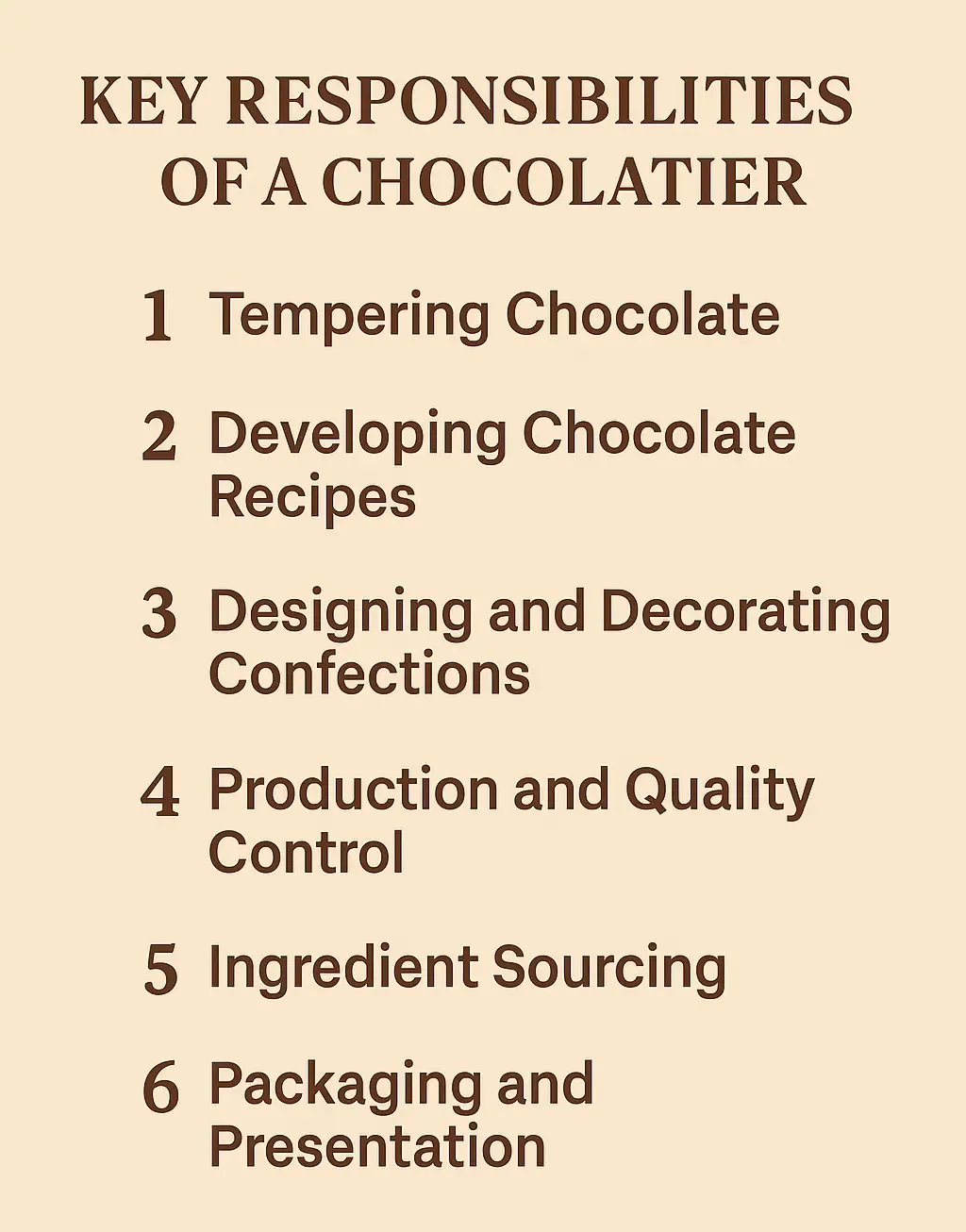
1. Tempering Chocolate
Tempering is perhaps the most essential — and technically demanding — skill a chocolatier must master. It involves carefully heating and cooling chocolate to stabilize the cocoa butter crystals, ensuring a glossy finish and crisp snap when the chocolate breaks.
Tempering is a meticulous process that requires careful attention to detail at every stage, as it directly affects the quality and appearance of the final product.
Tempering can be done using marble slab methods, seeding techniques, or specialized tempering machines, depending on the chocolatier’s setup.
A perfectly tempered batch is smooth, shiny, and resistant to bloom (the dull white streaks that appear when chocolate crystallizes improperly).
2. Developing Chocolate Recipes
Chocolatiers don’t just replicate existing confections — they invent new ones. They experiment with ganache ratios, fillings, flavor infusions, and textural elements.
Popular fillings include caramels, fruit purées, nut pralines, or liqueur blends. Chocolatiers craft a variety of chocolate pieces, often incorporating nuts, caramel, or other fillings to create unique treats.
Recipe development requires balancing sweetness, acidity, and bitterness, as well as understanding how different ingredients interact with cocoa solids. A successful chocolatier is part chef, part flavor chemist.
3. Designing and Decorating Confections
Presentation is crucial in luxury chocolate making. Chocolatiers use molds, airbrushing tools, edible paints, and transfer sheets to decorate chocolates.
Precision piping and hand-painting techniques elevate their work into miniature art pieces. Many artisanal chocolatiers also rely on traditional techniques passed down through generations to craft chocolates by hand, emphasizing authenticity and craftsmanship.
In addition to these methods, chocolatiers also create elaborate chocolate showpieces, which are edible art forms that showcase their artistic skills and craftsmanship.
Seasonal collections — like Valentine’s hearts or holiday truffles — often feature custom shapes, metallic dusting, or layered flavors to match the theme.
4. Production and Quality Control
Whether working independently or in a high-volume confectionery, chocolatiers oversee production from start to finish. This includes measuring ingredients, monitoring batch consistency, managing cooling tunnels or enrobing machines, and ensuring strict food safety compliance.
Maintaining consistency in texture, flavor, and appearance across hundreds (or thousands) of chocolates is a key challenge, especially when scaling artisan techniques for commercial production.
Many artisan chocolatiers produce chocolates in small batches to ensure quality and attention to detail.
5. Ingredient Sourcing
Chocolatiers pay close attention to ingredient quality — particularly the couverture chocolate they use. Many prefer single-origin chocolates sourced from countries like Ecuador, Ghana, or Madagascar, as each offers distinct flavor notes.
In addition to sourcing premium chocolate, they select nuts, dairy, fruits, and spices that complement their flavor profiles.
Chocolatiers carefully consider flavour profiles when choosing these ingredients to create distinctive chocolates.
Sustainability and fair-trade sourcing are becoming increasingly important in the modern chocolate industry.
6. Packaging and Presentation
A chocolatier’s work doesn’t end once the confections are made. They often design packaging that reflects their brand’s personality — elegant boxes, ribbons, or eco-friendly wraps.
Luxury chocolatiers pay as much attention to presentation as they do to taste, understanding that packaging contributes significantly to a product’s perceived value and gifting appeal.

Where Do Chocolatiers Work?
Chocolatiers can be found in a variety of settings, including:
- Boutique Chocolate Shops: Independent or family-owned stores focusing on handcrafted products.
- Hotel and Restaurant Kitchens: High-end establishments often employ in-house chocolatiers for desserts and plated creations, where they may collaborate with pastry chefs to create pastries and chocolate-based desserts.
- Chocolate Factories: Large brands like Godiva, Lindt, or Ghirardelli rely on teams of chocolatiers for research, product design, and quality testing.
- Culinary Schools or Workshops: Experienced chocolatiers often teach aspiring professionals, offering courses in tempering, molding, and decorating. Many programs include pastry arts and baking as part of the curriculum for aspiring chocolatiers.
Some chocolatiers even launch their own brands, selling products online or through specialty retailers.
Skills Every Chocolatier Needs
Being a chocolatier isn’t just about loving chocolate — it’s a meticulous craft that demands both technical and creative skills.
Core competencies include:
- Precision and attention to detail: Small temperature variations can make or break a batch.
- Creativity: Designing unique flavor combinations and visual presentations.
- Dexterity and patience: Hand-molding and decorating require a steady hand.
- Food science knowledge: Understanding emulsions, crystallization, and shelf-life.
- Business acumen: Managing inventory, marketing, and customer relations for independent chocolatiers.
- People skills: Essential for managing customer relations and working effectively in a team or with clients.
- Entrepreneurial skills: Critical for starting and running a successful chocolate business, including financial management and strategic planning.
Beyond skills, a chocolatier must have an artist’s eye and a scientist’s mindset — constantly testing, refining, and innovating their creations. Gaining practical experience through internships or apprenticeships with established chocolatiers is also invaluable for developing hands-on skills and industry insight.
Tools of the Trade
Every chocolatier relies on a core set of specialized equipment to maintain consistency and quality:
| Tool | Function |
|---|---|
| Thermometer | Ensures precise tempering temperatures |
| Chocolate tempering machine | Automates heating and cooling cycles |
| Molds | Shapes bonbons, bars, and pralines |
| Spatulas and scrapers | Used for spreading and tempering |
| Airbrush or spray gun | Applies color or cocoa butter designs |
| Cooling racks/tunnels | Solidify chocolate evenly |
| Digital scale | Guarantees accurate ingredient ratios |
Each tool serves a critical purpose in the chocolatier’s workflow — ensuring consistency, sanitation, and aesthetic precision.
The Creative Process Behind Chocolate Design
Before a chocolatier begins production, there’s an ideation phase where concepts are sketched, flavors tested, and prototypes made.
During this stage, chocolatiers strive to develop a unique style that sets their creations apart, encouraging personal expression and innovation. Inspiration often comes from seasons, cultural traditions, or even art movements.
For example:
- A spring collection might highlight floral notes like lavender or jasmine.
- A fall release could feature pumpkin spice, pecan praline, or bourbon caramel.
Once flavors are approved, the chocolatier documents recipes, molds designs, and sets production schedules.
Each new piece undergoes sensory evaluation for taste, texture, and aroma before it’s ready for sale.
Education and Training
While some chocolatiers are self-taught, many pursue formal training through culinary arts programs, pastry schools, or specialized chocolate academies. Aspiring chocolatiers often enroll in confectionery courses and baking and pastry arts programs as part of their proper education.
Institutions like The Culinary Institute of America (CIA) or École Chocolat offer professional certifications that cover everything from flavor chemistry to business management.
Formal education can provide a strong foundation, but real world experience and hands on exposure to the chocolate making process are equally important for mastering the craft.
Apprenticeships under master chocolatiers provide invaluable hands-on experience. Learning directly in a working chocolate kitchen teaches students to manage temperature, timing, and large-scale production demands — skills that can’t be learned from textbooks alone.
Check Our Career Growth Tools


Salary and Career Outlook
In the U.S., chocolatier salaries vary depending on experience, location, and employment type.
- Entry-level chocolatiers typically earn between $35,000 and $45,000 per year.
- Experienced or head chocolatiers at premium brands can make $60,000–$90,000 annually, with additional income from workshops or private commissions.
Those who open their own shops may earn significantly more, though income can fluctuate with seasonal demand and operating costs. Self employed chocolatiers often have higher earning potential but also face unique business challenges such as managing overhead and business risks.
With the rise of artisanal and ethically sourced chocolates, demand for skilled chocolatiers continues to grow in this competitive industry, and becoming a professional chocolatier requires dedication and skill.
Challenges of the Profession
Despite its romantic appeal, working with chocolate is demanding. Temperatures must be tightly controlled, and one small mistake can ruin an entire batch. Seasonal demand peaks during holidays, requiring long hours and careful planning.
Additionally, maintaining freshness and preventing bloom or melting during transport poses logistical challenges, especially for small businesses shipping nationwide.
Yet for most chocolatiers, the joy of seeing customers savor their creations makes every painstaking detail worthwhile.
Many chocolatiers around the world are dedicated to crafting delicious chocolate confections that delight customers and contribute to the rich, interconnected chocolate culture shared globally.
The Art Meets the Science
Ultimately, a chocolatier’s job is about evoking emotion through taste and beauty. Every truffle or praline tells a story — one of culture, craftsmanship, and creativity. The best chocolatiers aren’t just candy makers; they’re innovators who push the boundaries of what chocolate can be.
A master chocolatier or expert chocolatier demonstrates genuine love and passion for the craft, inspiring budding chocolatiers to pursue excellence.
Chocolatiers create chocolate in many other forms, from making chocolate candies to elaborate showpieces, showcasing their artistry and versatility.
Becoming a chocolate expert requires dedication, creativity, and a true passion for the world of chocolate.





Loading comments...