


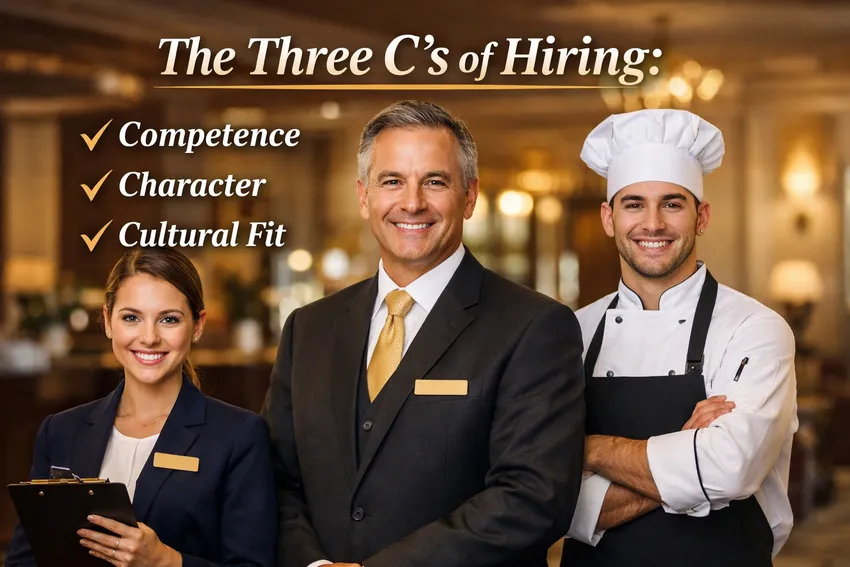

In today’s competitive job market, hiring the right employees is about more than just matching skills to a job description.
By focusing on the Three C’s, employers can build teams that not only perform well but also thrive together and contribute to long-term organizational success.

Understanding the Three C’s of Hiring
Below, we'll explore how competence, character, and cultural fit shape successful teams.



The Fastest Growing
Restaurant & Hospitality Job Platform
Looking for top paid jobs? Or Hiring for your business?
1. Competence
Competence is the foundation of any successful hire. It encompasses the knowledge, skills, and qualifications that a candidate brings to the table. Competence ensures that an employee can perform essential job tasks efficiently and meet organizational standards.
For example, a hotel front desk candidate may have prior experience managing check-ins, reservations, and guest inquiries, but competence also includes problem-solving skills, the ability to handle unexpected guest issues, and staying calm under pressure.
Hiring for competence in hospitality helps reduce training time, improves service quality, and allows teams to focus on creating memorable guest experiences rather than constantly addressing operational mistakes.
Signs of Competence in a Candidate:
| Indicator | What It Shows |
|---|---|
| Relevant work experience | Practical ability to handle job responsibilities |
| Professional certifications | Commitment to skill development and industry standards |
| Demonstrated problem-solving | Ability to tackle challenges independently |
Focusing solely on competence, however, can be misleading. A highly skilled employee may excel individually but struggle in team settings or clash with company values. That’s why character and cultural fit are equally important.
2. Character
Character is about integrity, reliability, work ethic, and interpersonal skills. While competence ensures a candidate can do the job, character determines how they do it and whether they can be trusted to uphold company values.
Employees with strong character contribute to a positive work environment. They are less likely to engage in unethical behavior, more likely to handle conflicts constructively, and better equipped to navigate challenges.
Character also predicts long-term retention; people who demonstrate resilience, accountability, and honesty tend to stay with companies that align with their principles.
Examples of Character Traits Employers Value:
- Integrity: Doing the right thing, even when no one is watching.
- Reliability: Meeting deadlines and fulfilling commitments consistently.
- Adaptability: Handling change and unexpected challenges effectively.
- Team Spirit: Supporting colleagues and collaborating on solutions.
Hiring for character reduces risk and ensures that new employees positively influence team morale and company reputation.
Check Our Career Growth Tools


3. Cultural Fit
Cultural fit refers to the alignment between a candidate’s values, behaviors, and work style with the organization’s culture. It’s crucial because even highly competent employees may struggle if they cannot integrate into the company’s environment.
For example, a highly experienced hotel concierge may excel in a fast-paced, luxury property that prioritizes individual initiative but could feel constrained in a smaller boutique hotel where teamwork and collaborative guest service are central.
Cultural fit in hospitality goes beyond personality—it includes shared values, communication styles, and alignment with the property’s approach to guest experience and service standards.
Benefits of Hiring for Cultural Fit:
- Higher Engagement: Employees who resonate with company culture are more motivated and productive.
- Lower Turnover: Misaligned hires often leave quickly, increasing recruitment costs.
- Stronger Team Cohesion: Teams with aligned values experience better collaboration and less conflict.
Employers should assess cultural fit through behavioral interview questions, scenario-based assessments, and evaluating alignment with company mission statements.
Balancing the Three C’s in Hiring
The most successful hiring decisions consider all three C’s simultaneously. A candidate with high competence but poor character or cultural fit may create tension or disrupt workflow. Conversely, a candidate with strong character and cultural alignment but insufficient skills may require extensive training or struggle to meet performance goals.
Example:
| Candidate | Competence | Character | Cultural Fit | Likely Outcome |
|---|---|---|---|---|
| A | High | Low | Medium | May underperform socially, disrupt teams |
| B | Medium | High | High | Likely to grow into role with training, retain longer |
| C | High | High | High | Ideal hire, high productivity, low turnover risk |
To achieve a balanced evaluation, companies often use multi-step recruitment processes, including:
- Structured interviews
- Skills assessments
- Personality and values assessments
- Reference checks
This approach ensures that candidates are evaluated holistically, reducing hiring mistakes and improving long-term team performance.
Why the Three C’s Matter More Than Ever
In today’s competitive U.S. job market, the cost of a bad hire can be substantial. According to the Society for Human Resource Management (SHRM), replacing an employee can cost up to six to nine months of their salary.
By applying the Three C’s framework, employers can:
- Identify employees who are likely to stay longer
- Improve overall team productivity
- Foster a positive, collaborative workplace
- Reduce hiring and training costs
Additionally, the emphasis on workplace culture means that character and cultural fit are now as important as technical skills.
Candidates who thrive in flexible, collaborative environments will drive innovation and long-term success.

Tips for Implementing the Three C’s in Your Hiring Process
- Define Your Company Culture Clearly: Use mission statements and core values to guide cultural fit evaluations.
- Create Skills Assessments: Test candidates’ technical competence before making final hiring decisions.
- Behavioral Interviews: Ask questions that reveal integrity, teamwork, and problem-solving abilities.
- Reference Checks: Validate both competence and character by speaking with previous employers.
- Continuous Feedback: Adjust hiring criteria based on employee performance and retention data.
The Fastest Growing
Restaurant & Hospitality Job Platform
Looking for top paid jobs? Or Hiring for your business?
Common Mistakes When Ignoring the Three C’s
- Hiring solely for skills without considering character or cultural fit
- Overlooking personality traits that may conflict with team dynamics
- Relying on gut feeling instead of structured evaluation methods
- Neglecting to update hiring criteria as company culture evolves
Companies that fail to balance these factors often experience high turnover, decreased morale, and reduced productivity.
Conclusion
The Three C’s of Hiring—Competence, Character, and Cultural Fit—provide a holistic framework for making smarter hiring decisions.
Companies that apply this framework thoughtfully are more likely to hire employees who excel in their roles, enhance team dynamics, and remain committed to the organization long-term.
By integrating structured assessments, behavioral interviews, and cultural evaluations, employers can reduce turnover, boost productivity, and build a workforce that drives sustainable success.
The Three C’s are not just a hiring checklist—they are a roadmap to creating thriving, cohesive, and high-performing teams.


Loading comments...