




Split tips by hours is a tip distribution method that allocates tips based on the number of hours each employee works.
This system promotes fairness, transparency, and consistency in team compensation.
In this article, we explore three key takeaways that highlight the benefits and practical impact of using this method.

What Is Tip Pooling?
Tip pooling is a system in which restaurant staff contribute their tips to a collective pool.
This pool is then redistributed based on predetermined rules, one of which is to split tips by hours worked.
For example, in the restaurant industry, it is common for front-of-house staff like Waiters and Waitresses to receive tips directly from customers.
Meanwhile, back-of-house staff like Dishwashers and Cooks do not.
With tip pools, other staff who contribute to patrons’ overall dining experience can also boost their earnings through tips.



The Fastest Growing
Restaurant & Hospitality Job Platform
Looking for top paid jobs? Or Hiring for your business?
Tip Pool Formula: Splitting Tips by Hours Worked
When dividing tips based on hours worked, you need to find the value of each hour worked and then multiply that value by the hours each employee worked.
The tip pool formula (sometimes called a “tip share formula”) is as follows:
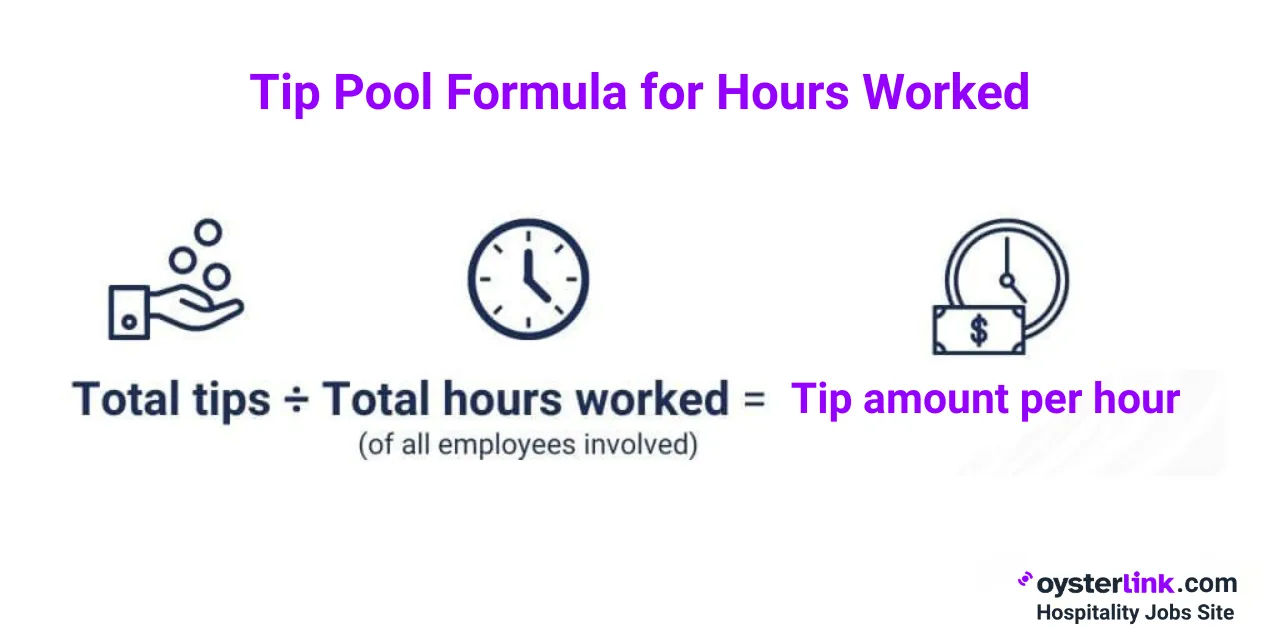
To do this, follow the steps below:
- Calculate the total tips collected and the total hours worked by all employees.
- Divide the total tips by the total hours worked. This gives the tip amount per hour.
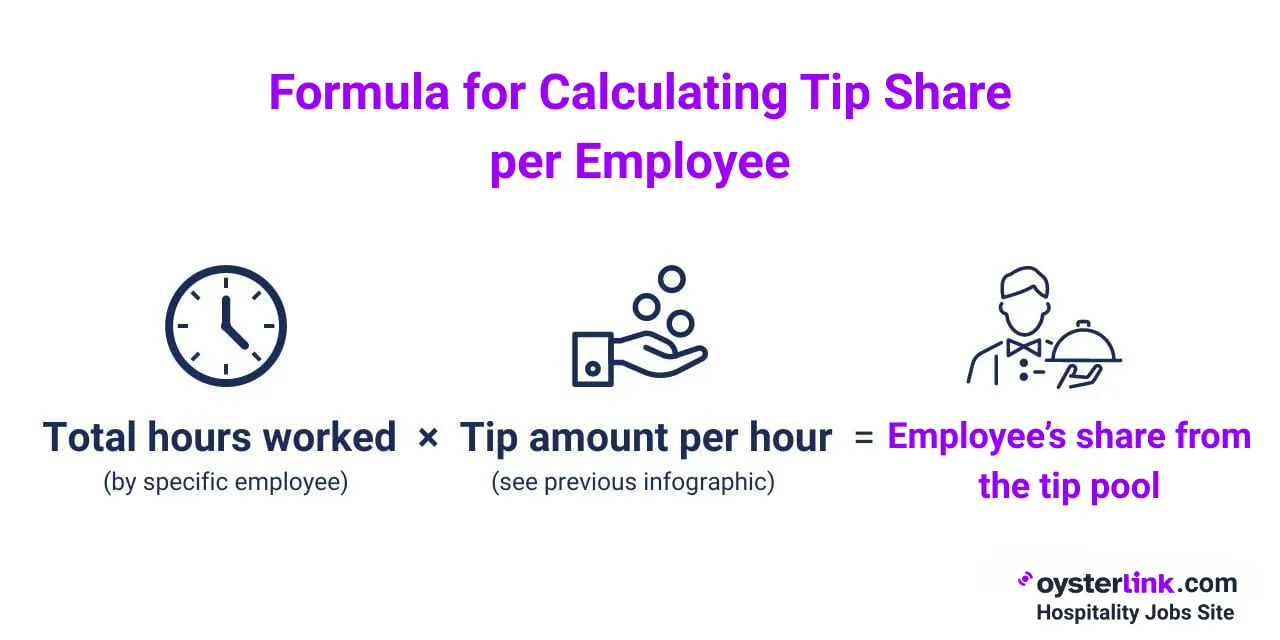
- Multiply the tip amount per hour by each employee’s hours worked to determine their share.
For example, let’s say all your employees worked a total of 25 hours and received a total tip amount of $600, then you can follow the steps below:
- Total tips: $600
- Total hours worked: 25 (Employee 1: 9 hours, Employee 2: 10 hours, Employee 3: 6 hours)
- Tip per hour: $600 ÷ 25 = $24/hour

This means for each hour worked, an employee receives $24 in tips, respectively. For the employees above, this is how much they should receive:
- Employee 1: 9 (hours) × $24 = $216
- Employee 2: 10 (hours) × $24 = $240
- Employee 3: 6 (hours) × $24 = $144
To get the employee’s share in a tip pool, you can use the following formula:
Difference Between Tip Pooling and Tip Splitting
As discussed, tip pooling involves collecting all tips and redistributing them according to a set formula or system.
On the other hand, tip splitting, or tip sharing*, usually involves dividing tips among employees based on pre-set percentages or specific roles, rather than hours worked.
For example, under this system, Servers might keep a percentage while tipping out Bartenders or Bussers.
Check Our Career Growth Tools


Keep in mind that tipping laws and guidelines vary by state. Check out our labor law guides for key federal and state labor laws and insights.
Other Ways To Split Tips Among Restaurant Employees
There are different methods for splitting tips exist — each with its own advantages depending on the business setup and team structure.
Two common alternatives are percentage-based and points system splitting.
Splitting Tips Based on Percentage
In this system, specific roles receive a set percentage of the total tips.
For instance, Servers could receive 70% of the total tips, and the remaining 30% could be divided among Bartenders and Bussers.
Example:
- Total tips: $1,000
- Servers receive 70%: $1,000 × 0.70 = $700
- Bartenders and Bussers share 30%: $1,000 × 0.30 = $300
Splitting Tips Based on Point System
Percentage-based tip splitting is a point system in which each role is assigned a different value.
Roles that are more difficult or that tend to interact more directly with customers are often assigned a higher point value.
Example:
- Server = 30 points, Bartender = 15 points, Busser = 5 points
- Total points = 50
- Tip per point: $1,000 ÷ 50 = $20/point
Tip distribution:
- Server: 30 × $20 = $600
- Bartender: 15 × $20 = $300
- Busser: 5 × $20 = $100
Pros and Cons of Splitting Tips by Hours
Before implementing a tip pooling system, it’s best to understand its pros and cons.
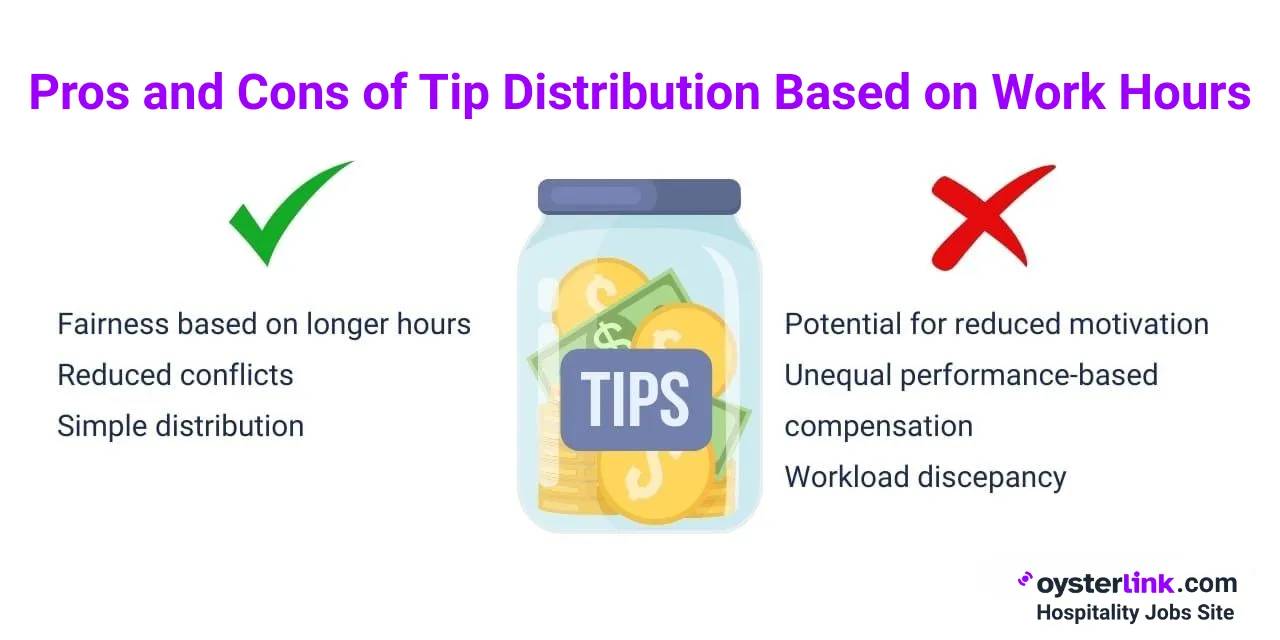
Understanding the pros and cons of splitting tips by hours can help businesses decide whether this method is suitable for them or whether they may need to follow a different system.
Pros
The fairness of this system ensures that employees are compensated according to the hours they’ve worked, with longer shifts resulting in a larger share of tips.
By focusing solely on hours worked, it prevents conflicts over who had better tables or higher-paying customers, reducing friction among staff members.
Splitting tips by hours also simplifies the distribution process, making it easier for management to distribute tips equitably and ensure smooth restaurant operations.
Cons
Splitting tips by hours can discourage top performers since effort isn’t directly rewarded.
It may also feel unfair to employees working peak, high-pressure shifts who earn the same as those on slower hours.

Tips and Advice for Restaurant Owners on Tip Pooling
No matter what you decide on how to split tips per hours among employees, OysterLink simplifies managing tip pooling, staffing and hiring with easy-to-use solutions designed for restaurant owners.
Explore our restaurant career advice and other hiring tips today.
The Fastest Growing
Restaurant & Hospitality Job Platform
Looking for top paid jobs? Or Hiring for your business?





Loading comments...