


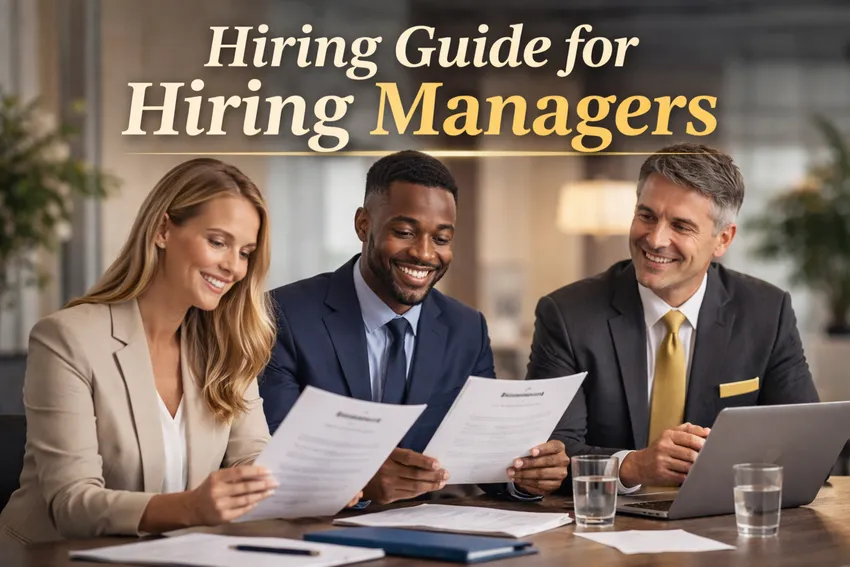

In today’s competitive U.S. labor market, hiring managers must go beyond reviewing resumes and conducting interviews.
Success depends on creating a comprehensive hiring strategy that attracts high-quality candidates, accurately evaluates skills, and ensures new hires align with team and company culture.
This guide covers every stage of the hiring process, from job posting to onboarding, providing practical tips for managers across industries.

Introduction to the Hiring Process
The hiring process is the foundation for building a strong team and ensuring long-term success for your organization.
As a hiring manager, your role is to guide this process from start to finish, beginning with a clear job description and ending with the selection of the best candidate for the position.
A consistent process, supported by a structured interview guide, helps you evaluate candidates fairly and efficiently.
By following a step-by-step approach, you can ensure that every interview, assessment, and decision is aligned with your team’s needs and company goals.
This hiring guide will walk you through each stage of the hiring process, offering practical tips to help you select the right person for your team and set them up for success in their new role.



The Fastest Growing
Restaurant & Hospitality Job Platform
Looking for top paid jobs? Or Hiring for your business?
1. Planning and Preparing for Hiring
Before posting a job, hiring managers must take time to define the role clearly and understand the skills, experience, and personal traits required.
Key steps in planning:
- Job Analysis: Identify responsibilities, key performance indicators (KPIs), and necessary qualifications.
- Role Requirements: Decide which skills are essential versus desirable.
- Team Fit: Consider how this role complements existing team strengths and addresses gaps.
- Budget and Compensation: Set a realistic salary range and benefits package to attract competitive candidates.
- Prepare for Interviews: Prepare thoroughly by developing scorecards, formulating interview questions, and understanding the role and company to ensure a fair and comprehensive evaluation process.
- Align with Recruiters: Align with recruiters and optimize the entire hiring journey from sourcing to onboarding.
- Needs Analysis: Conduct a thorough needs analysis to identify leadership gaps and challenges for new managers.
- Sourcing Tools: Employ sourcing tools, AI, and social media to find candidates.
Before posting job openings, recruiters and hiring managers should align on essential skills and set clear expectations for the hiring timeline.
Planning thoroughly reduces wasted time and ensures the hiring process is focused and efficient. A clear, accurate, and compelling job description helps candidates determine if they are the right fit for the role.
2. Crafting an Effective Job Description
A clear, well-written job description is your first opportunity to attract qualified candidates. Include:
- Job Title: Be precise and searchable (e.g., “Front Desk Supervisor – Full Time, Luxury Hotel”).
- Responsibilities: Outline day-to-day duties and expectations.
- Required Skills: Specify technical, interpersonal, and industry-specific skills.
- Company Culture and Values: Highlight what makes your organization unique.
- Salary and Benefits: Clearly state salary range and benefits to set expectations.
- Application Instructions: Provide clear guidance for submitting resumes or portfolios.
Use clear, jargon-free language throughout the job description to ensure it is accessible to all candidates. Avoid any personal questions or references to family or religion to maintain professionalism and comply with legal guidelines.
An optimized job description ensures candidates understand the role and self-select for relevance, helping them determine if they are the right fit and saving managers significant screening time.
Check Our Career Growth Tools


3. Sourcing Candidates
Finding the right talent requires using a mix of platforms and outreach strategies:
Primary channels include:
- Hospitality Job Boards: Platforms like OysterLink specialize in hotel, restaurant, and service industry talent.
- General Job Boards: Indeed, Glassdoor, and LinkedIn help expand reach for volume or entry-level roles.
- Company Career Pages: Attracts candidates already aligned with company culture and interested in your organization.
- Social Media Recruiting: Share openings on LinkedIn, Facebook, and Instagram to reach passive and active candidates. Employ sourcing tools, AI, and social media to find and engage candidates efficiently.
- Employee Referrals: Incentivized referral programs often produce highly qualified, trustworthy hires.
Proactively engage with potential candidates through industry events or by sharing relevant content before roles are open. This helps build a pipeline of interested talent who are more likely to be motivated and suitable for future opportunities.
Using multiple channels ensures a diverse candidate pool while targeting industry-specific talent efficiently.
4. Screening and Interviewing
Once candidates apply, structured evaluation is critical. Screening should assess both competence and character, not just qualifications. It is important to be honest and admit any personal biases that may influence your decisions, ensuring a fair and objective process.
Screening Tips:
- Resume Review: Look for relevant experience, certifications, and career progression.
- Phone or Video Interviews: Confirm basic qualifications, availability, and communication skills.
- Behavioral Assessments: Use scenario-based questions to evaluate problem-solving, teamwork, and ethical judgment.
- Prepare a standardized interview scorecard or rubric with scoring scales for core competencies to ensure consistent evaluation of all candidates.
- Use structured interviews with the same set of questions and scoring criteria for every candidate. This keeps the process fair and consistent, allowing for easier comparison and reducing bias.
- Use behavioral questions and follow-up questions to gain detailed answers and concrete examples from candidates, helping to determine their fit for the role.
- Encourage candidates to answer questions thoughtfully and to ask their own questions, as this reveals their motivations and interest.
- Evaluate a candidate's ability—including communication, problem-solving, adaptability, and technical knowledge—using practical assignments or leadership simulations that emulate real job tasks.
- Take notes during interviews and use them immediately after for accurate debriefs and to support data-driven assessments.
- Conduct thorough reference checks to verify employment history and reputation.
- Treat candidates like customers by providing clear timelines, setting expectations, and informing them of their status throughout the process.
- Replace gut feelings with data-driven assessments to minimize unconscious bias.
- Avoid personal questions (such as family or religion) to maintain professionalism and focus on qualifications.
- Use a combination of questions about hard and soft skills for a well-rounded view of the candidate.
- Present information clearly and explain steps or expectations to candidates to ensure transparency.
- Recognize the tough decisions involved in choosing between great candidates and focus on the qualities most needed for the role.
- Maintain hope and optimism in finding good candidates and making successful hires.
- Be honest in communication about expectations, workplace culture, and any limitations to build trust.
- Share how you have dealt with tough situations or challenges in the interview process to continuously improve.
- Assess a candidate's ability to speak and present their work effectively, as well as their use of real-world examples to demonstrate experience and problem-solving.
- Use structured questions and assessments to determine candidate fit for the position.
Interview Best Practices:
- Use a structured interview format to compare candidates fairly.
- Include multiple interviewers to provide balanced perspectives.
- Ask questions targeting the Three C’s of Hiring: Competence, Character, and Cultural Fit.
Structured interviewing improves hiring accuracy and ensures managers make data-driven decisions.
Effective Questioning Techniques
Asking good questions is at the heart of a successful hiring process. Using a structured interview guide ensures that the same questions are asked to every candidate, making it easier to compare their responses and evaluate their fit for the job.
Focus on open-ended, behavioral questions that encourage candidates to share examples from their past experiences, such as “Can you tell me about a time when you overcame a challenge at work?” or “How would you handle a conflict with a team member?”
These types of questions help you assess both hard and soft skills, as well as how well a candidate might fit into your company culture.
Avoid simple yes/no questions, and instead, use your interview guide to dig deeper into a candidate’s abilities, values, and potential for future success.
The Fastest Growing
Restaurant & Hospitality Job Platform
Looking for top paid jobs? Or Hiring for your business?
Using a Structured Interview Guide
A structured interview guide is an essential tool for any hiring manager aiming to create a fair and effective hiring process.
By asking the same questions and using the same criteria to evaluate each candidate, you ensure a consistent process that minimizes bias and focuses on what matters most for the job.
This approach keeps interviews focused on the key skills and experiences required for the position, making it easier to identify the best fit for your team and company culture.
With a structured interview guide, managers can confidently compare candidates, make data-driven decisions, and create a transparent process that supports both the organization and the candidates.
5. Assessing Cultural Fit
Cultural fit is often as important as technical ability. Employees who align with company values are more likely to stay longer, perform better, and positively impact team morale.
Assessment Methods:
- Discuss company mission and values during the interview.
- Pose questions about handling conflict, collaboration, or customer service challenges.
- Include team members in interviews to gauge interpersonal chemistry.
Cultural alignment reduces turnover and fosters a cohesive, productive workplace.
Avoiding Common Mistakes
Even experienced hiring managers can fall into common traps during the hiring process. One frequent mistake is neglecting to use a structured interview guide, which can lead to inconsistent questioning and make it difficult to fairly evaluate candidates.
Another pitfall is failing to take notes during interviews, which can result in forgetting important details or misremembering a candidate’s answers.
It’s also important to keep small talk relevant and focused on the job, rather than letting the conversation drift away from assessing the candidate’s skills and experience.
Watch for red flags, such as a lack of enthusiasm or inconsistent responses, and don’t hesitate to follow up with clarifying questions if you have concerns.
By staying focused, taking thorough notes, and using a structured process, hiring managers can avoid common mistakes and increase the likelihood of selecting the right person for the job.

6. Making the Job Offer
A well-structured offer communicates professionalism and reinforces your company brand:
- Be Timely: Deliver the offer promptly to maintain candidate interest. Good candidates often receive multiple offers, so acting quickly and presenting an attractive and competitive offer is essential to secure top talent before they accept other opportunities.
- Be Clear: Include salary, benefits, start date, and reporting structure.
- Be Flexible: Allow room for negotiation when appropriate.
- Communicate Next Steps: Outline onboarding and any pre-employment requirements. A well-structured offer and onboarding plan help new hires join the team smoothly and feel welcomed.
Prompt and transparent offers improve acceptance rates and create a positive candidate experience.
7. Onboarding New Hires
Hiring doesn’t end with an accepted offer. Effective onboarding ensures employees integrate successfully and reach productivity faster.
Onboarding Best Practices:
- Provide a structured training program tailored to the role.
- Assign a mentor or buddy for guidance and cultural integration.
- Set early performance expectations and provide regular feedback.
- Encourage social integration with team introductions and participation in company activities.
Well-designed onboarding improves retention, engagement, and overall employee satisfaction.
8. Metrics and Continuous Improvement
Hiring managers should track key metrics to improve processes over time:
- Time-to-Hire: Average duration from posting to offer acceptance.
- Retention Rate: How many hires stay beyond 6–12 months.
- Quality of Hire: Performance evaluations during the first year.
- Candidate Experience: Feedback on the hiring process.
Using metrics allows managers to refine sourcing strategies, interview processes, and onboarding programs to maximize hiring success.

Loading comments...