


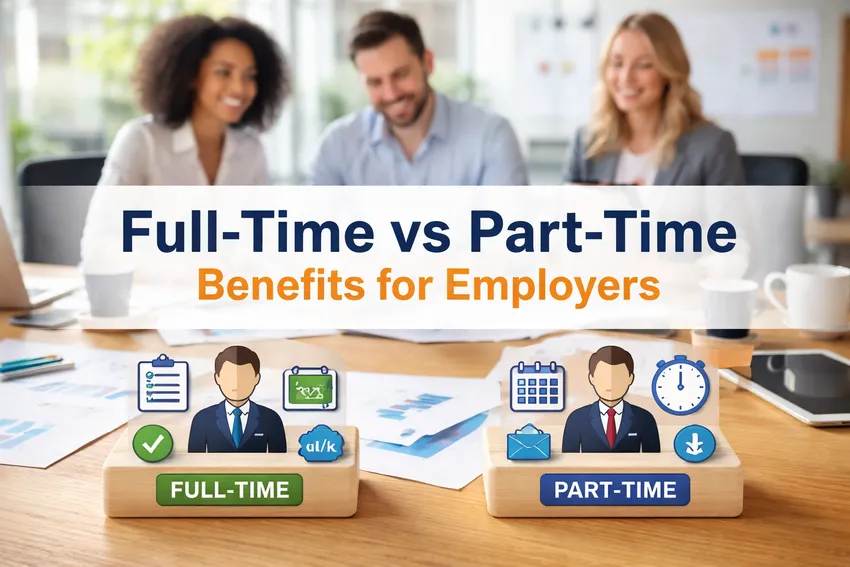

Workforce planning has evolved dramatically over the last decade. Companies no longer rely exclusively on traditional full-time employees; instead, many organizations now blend full-time and part-time roles to achieve operational efficiency.
For employers, deciding how to structure benefits for these different employment types can influence hiring costs, retention, productivity and long-term growth.
Understanding the difference between full-time and part-time benefits isn’t simply an HR detail—it’s a strategic decision that affects payroll budgets, employee engagement and legal compliance.
While full-time roles generally include broader benefits packages, part-time roles can provide flexibility and cost advantages when used correctly.

Understanding Full-Time vs Part-Time Employment
Before diving into benefits, it’s essential to clarify what qualifies as full-time versus part-time work.
In the United States, full-time employment is typically defined as 30–40 hours per week, depending on the employer or legal context.
The Internal Revenue Service considers an employee full-time if they average at least 30 hours per week or 130 hours per month for the purposes of the Affordable Care Act (ACA).
Part-time employees generally work fewer than 30 hours weekly, though exact definitions vary by organization.
The U.S. Bureau of Labor Statistics often categorizes workers logging fewer than 35 hours per week as part-time.
Importantly, federal law does not mandate a universal definition. The Fair Labor Standards Act (FLSA) leaves the classification largely to employers, allowing businesses to determine schedules and benefit eligibility policies internally.
Because of this flexibility, companies must clearly outline classifications and benefit eligibility in employee handbooks and HR policies.



The Fastest Growing
Restaurant & Hospitality Job Platform
Looking for top paid jobs? Or Hiring for your business?
Typical Benefits Offered to Full-Time Employees
Full-time employees traditionally receive the most comprehensive benefits packages. These benefits are designed to attract experienced talent and promote long-term commitment to the organization.
Common full-time benefits include:
Health and Insurance Benefits
Many companies offer medical, dental and vision insurance to full-time workers. Health coverage remains one of the most significant incentives employees consider when evaluating job offers.
Additional insurance benefits may include:
- Life insurance
- Disability insurance
- Mental health programs
These benefits not only protect employees but also reduce absenteeism and increase productivity.
Paid Time Off (PTO)
Full-time workers usually receive paid vacation days, sick leave and paid holidays. Employers often provide maternity or parental leave as part of their benefits package.
PTO policies vary widely between organizations, but they play a major role in employee satisfaction and work-life balance.
Retirement Plans
Many employers offer retirement benefits such as 401(k) plans with matching contributions. Retirement programs encourage employees to stay with a company longer, reducing turnover and recruitment costs.
Additional Employer-Sponsored Benefits
Some organizations provide optional perks like:
- Tuition reimbursement
- Flexible spending accounts (FSAs)
- Wellness programs
- Employee discounts
While these benefits are not legally required, they help companies compete for talent in tight labor markets.
Benefits Typically Offered to Part-Time Employees
Part-time employees historically receive fewer benefits than their full-time counterparts. However, the landscape is slowly shifting as employers attempt to attract and retain flexible talent.
Check Our Career Growth Tools


Limited or Prorated Benefits
Many companies provide limited benefits to part-time employees, such as:
- Prorated paid time off
- Access to retirement plans after meeting hour requirements
- Limited health coverage options
For example, PTO may be calculated based on the number of hours worked rather than provided as a fixed amount.
Mandatory Benefits
Despite reduced benefits packages, part-time workers still qualify for certain statutory protections and programs.
Examples include:
- Social Security and Medicare contributions
- Workers’ compensation
- Overtime pay if eligible
Some retirement laws also require employers to allow long-term part-time workers to participate in retirement plans after meeting specific service thresholds.
Optional Employer Benefits
Forward-thinking employers increasingly offer benefits to part-time staff, including:
- Flexible scheduling
- Professional development opportunities
- Partial health insurance coverage
Providing these perks can improve morale and reduce turnover in industries that rely heavily on part-time workers.
Key Differences Between Full-Time and Part-Time Benefits
Although benefits vary by company, several consistent differences distinguish full-time and part-time employment.
| Category | Full-Time Employees | Part-Time Employees |
|---|---|---|
| Weekly Hours | Typically 30–40+ hours | Usually under 30 hours |
| Health Insurance | Commonly offered | Often unavailable or limited |
| Paid Time Off | Standard benefit | Often prorated |
| Retirement Plans | Frequently included | Sometimes available after eligibility period |
| Job Stability | Higher | Lower or seasonal |
Full-time workers generally receive broader benefits because employers expect them to contribute long-term value to the organization. Part-time roles, by contrast, prioritize flexibility and reduced operational costs.
Advantages of Full-Time Benefits for Employers
Providing robust benefits to full-time employees offers several strategic advantages.
Stronger Employee Loyalty
Workers who receive comprehensive benefits are more likely to stay with their employer. Health insurance, retirement contributions and PTO create financial security and encourage long-term commitment.
Lower turnover translates to:
- Reduced hiring costs
- Less training time
- Greater operational consistency
Higher Productivity and Engagement
Full-time employees typically develop deeper expertise within their roles. Because they spend more hours within the organization, they build stronger relationships with coworkers and customers.
This familiarity can increase efficiency and overall business performance.
Improved Employer Brand
Companies known for generous benefits packages often attract higher-quality candidates. Competitive benefits help organizations stand out in crowded job markets, particularly in industries facing labor shortages.
Advantages of Part-Time Benefits for Employers
While full-time roles provide stability, part-time employment offers several advantages for businesses.
Greater Workforce Flexibility
Part-time employees allow companies to adjust staffing levels quickly based on demand. Businesses with seasonal fluctuations—such as hospitality, retail or tourism—can benefit greatly from part-time scheduling.
Employers can scale staffing during peak periods without committing to long-term payroll expenses.
Lower Labor Costs
Because part-time workers often receive fewer benefits, companies may reduce expenses associated with healthcare, paid leave and retirement contributions.
This cost efficiency can be especially valuable for small businesses or startups operating on limited budgets.
Access to Broader Talent Pools
Part-time roles attract workers who may not be available for full-time employment, including:
- Students
- Parents
- Retirees
- Freelancers
By offering flexible schedules, employers can tap into talent pools that would otherwise remain inaccessible.
Legal Considerations for Employer Benefits
Employers must carefully design benefit structures to comply with federal and state regulations.
Affordable Care Act (ACA)
Under the ACA, companies with 50 or more full-time equivalent employees (FTEs) must offer health insurance to employees who work at least 30 hours per week. Failure to provide coverage may result in penalties.
Overtime Regulations
The FLSA requires overtime pay for non-exempt employees who work more than 40 hours in a workweek, regardless of full-time or part-time status.
Anti-Discrimination Laws
Both full-time and part-time employees are protected under federal employment laws that prohibit discrimination based on race, gender, age or disability.
Employers must ensure that benefit structures do not unfairly discriminate against protected groups.
How Employers Can Balance Benefits for Both Groups
Modern organizations increasingly adopt hybrid workforce models. To maximize efficiency, employers should create benefit strategies that support both full-time and part-time staff.
1. Offer Tiered Benefits
Some companies provide different levels of benefits based on hours worked.
For example:
- Full-time employees receive complete benefits
- Part-time employees receive limited or prorated benefits
This approach balances fairness with cost control.
2. Introduce Flexible Benefit Programs
Flexible benefits allow employees to choose from various perks based on their needs.
Examples include:
- Lifestyle spending accounts
- Flexible work arrangements
- Remote work options
These benefits appeal to both full-time and part-time employees without dramatically increasing costs.
3. Invest in Employee Development
Training and career growth opportunities benefit all workers regardless of schedule.
Providing mentorship, certifications or career pathways helps employers build a more skilled and loyal workforce.
4. Use Data-Driven Workforce Planning
Employers can analyze productivity, labor costs and turnover data to determine the optimal mix of full-time and part-time employees.
Using workforce analytics helps businesses:
- Control payroll costs
- Maintain service quality
- Improve staffing efficiency
Industries Where Part-Time Benefits Matter Most
Certain industries rely heavily on part-time employment and must design competitive benefits to attract workers.
Examples include:
- Hospitality and restaurants
- Retail
- Healthcare
- Education
- Customer service
These sectors often experience high turnover, making employee benefits an essential retention tool.
Even small perks—such as scheduling flexibility or performance bonuses—can significantly improve employee satisfaction.
Future Trends in Employer Benefit Strategies
Workplace expectations are shifting rapidly. Several trends are shaping how employers approach benefits for both full-time and part-time workers.
Expanded Benefits for Part-Time Workers
Many companies are gradually offering more benefits to part-time employees to compete for talent.
These may include:
- Paid sick leave
- Partial healthcare coverage
- Retirement plan access
Flexible Work Models
Remote work and hybrid schedules allow employers to offer flexibility without necessarily expanding traditional benefits.
Personalized Benefits Packages
Instead of standardized benefits, companies increasingly provide customizable options that employees can tailor to their personal needs.


Loading comments...