


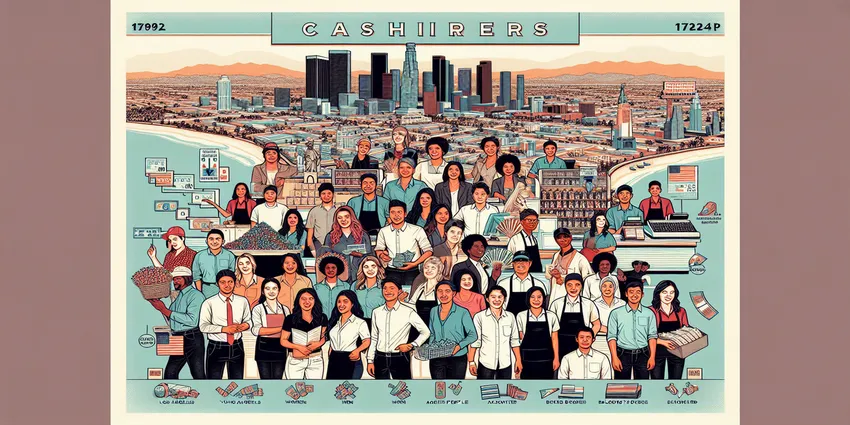

Los Angeles Workforce Demographics for Cashier: Key Takeaways
- Approximately 71% of cashiers nationwide are women, and the average age is 32.2 years.
- Educationally, 48% of U.S. cashiers hold a high school diploma, 20% a bachelor's, and 16% an associate degree.
- Los Angeles' diverse population, with a significant Hispanic or Latino presence, influences its cashier workforce demographics.
Understanding the demographics of cashiers in Los Angeles sheds light on age, gender, and education patterns in this vital workforce segment.
This overview connects national cashier trends with Los Angeles' unique population profile to form a broad understanding.
Employers looking to hire for cashier roles will find our guide on how to hire a cashier particularly useful in developing effective recruitment strategies.
1. Age and Gender Demographics of Cashiers in Los Angeles

The cashier workforce in the U.S. is predominantly female, with women making up about 71% and men 29%. This gender distribution is expected to reflect closely in Los Angeles given the city's size and employment patterns.
Cashiers have an average age of 32.2 years nationwide, which suggests a relatively young workforce. In Los Angeles, which attracts a mix of younger and working-age residents, it is reasonable to expect a similar age profile among cashiers.
The significant Hispanic or Latino community in Los Angeles also influences the makeup of the cashier workforce, potentially leading to a diverse mix of ages within this ethnic group.
Those interested in cashier career specifics may explore the cashier job description to better understand the role and expectations.
2. Educational Attainment Among Los Angeles Cashiers
Education levels among cashiers nationally show nearly half (48% hold a high school diploma). Additionally, 20% have earned a bachelor's degree, and 16% hold an associate degree. These figures indicate that while many cashiers have completed high school, a substantial portion pursue higher education.
Looking at Los Angeles citywide education statistics, 21.1% are high school graduates, 16.7% have some college but no degree, and 19.2% hold a bachelor's degree. Given these figures, it is plausible that Los Angeles cashiers have educational attainment levels comparable to or slightly differing from national numbers due to the city's diverse socioeconomic landscape.
This blend of education suggests that cashier roles in Los Angeles attract both entry-level workers and individuals pursuing part-time or flexible employment while continuing their education.
To support managerial staff, reviewing our how to hire a restaurant manager guide can be highly beneficial for structuring your team effectively.



The Fastest Growing
Restaurant & Hospitality Job Platform
Looking for top paid jobs? Or Hiring for your business?
3. Influence of Los Angeles Demographics on Cashier Workforce
Los Angeles has one of the most diverse populations in the United States. A large proportion of residents identify as Hispanic or Latino, which influences employment sectors including cashier positions.
This ethnic diversity likely contributes to a multicultural cashier workforce, reflective of the city’s overall population makeup. Multilingual and culturally fluent workers may be more common in Los Angeles cashier roles than in less diverse areas.
Additionally, variations in income levels and educational opportunities across the city may impact who fills cashier positions, with some workers viewing these roles as stepping stones within the retail and service industries, or as temporary employment while seeking other opportunities.
Employers may also benefit from our restaurant staff hiring spotlight that covers effective recruitment methods in diverse markets like Los Angeles.
4. Overview of Cashier Workforce Trends in Los Angeles
Although direct statistics specific to Los Angeles cashiers are limited, combining national trends with the city’s demographic data provides helpful insights.
We can expect the cashier workforce to be mostly female, around their early 30s, and have varying education levels from high school diplomas to college degrees.
Furthermore, the cultural diversity in Los Angeles means this workforce likely represents a mix of ethnicities and languages. Employers may find that bilingual skills and cultural competence are valuable assets for cashier roles here.
This workforce segment plays a vital role in retail and service industries in Los Angeles, impacting local economies and community interactions.
For employers managing varied restaurant roles, our restaurant positions descriptions spotlight offers comprehensive role overviews, including cashier and related service staff.
5. Key Resources for More Information on Los Angeles Cashier Demographics
For those seeking more detailed and updated information regarding cashier demographics both nationally and in Los Angeles, these resources are valuable starting points:
- U.S. Bureau of Labor Statistics: Cashiers Occupational Outlook Handbook offers comprehensive labor statistics.
- Data USA: Cashiers Profile provides an in-depth look at demographic and workforce data across the U.S.
- U.S. Census Bureau: American Community Survey is a rich source for population and education data in Los Angeles and nationwide.

Los Angeles Workforce Demographics for Cashier: Conclusion
The cashier workforce in Los Angeles reflects broader national patterns in age, gender, and education, while also being uniquely shaped by the city’s rich cultural and demographic diversity.
Women dominate the cashier field, the average age is in the early 30s, and educational backgrounds vary widely from high school diplomas to bachelor’s degrees.
Given the city's diverse population and cultural mix, cashiers in Los Angeles also tend to embody multilingual and multicultural competencies that are crucial in serving a varied clientele.
By leveraging these insights, employers, policymakers, and workforce planners in Los Angeles can better understand and support this important segment of the workforce.
Employers seeking to enhance their hiring knowledge may find our spotlight on how to hire high performers especially insightful to attract the best talent.





Loading comments...