


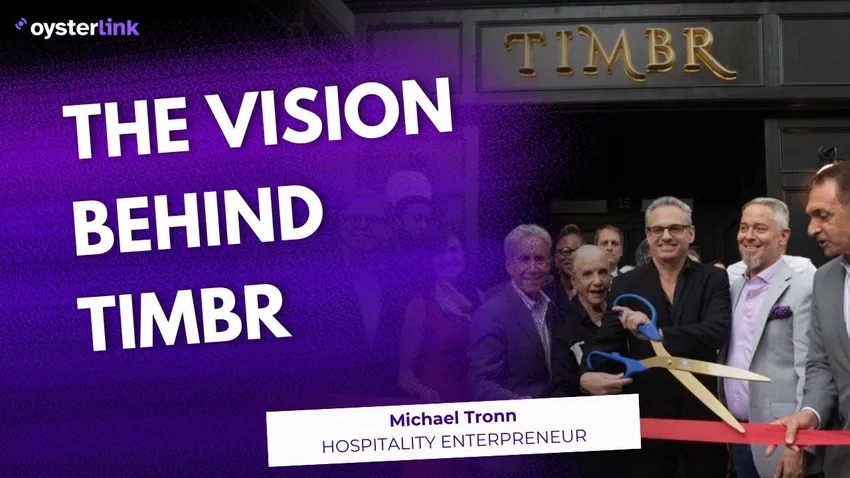

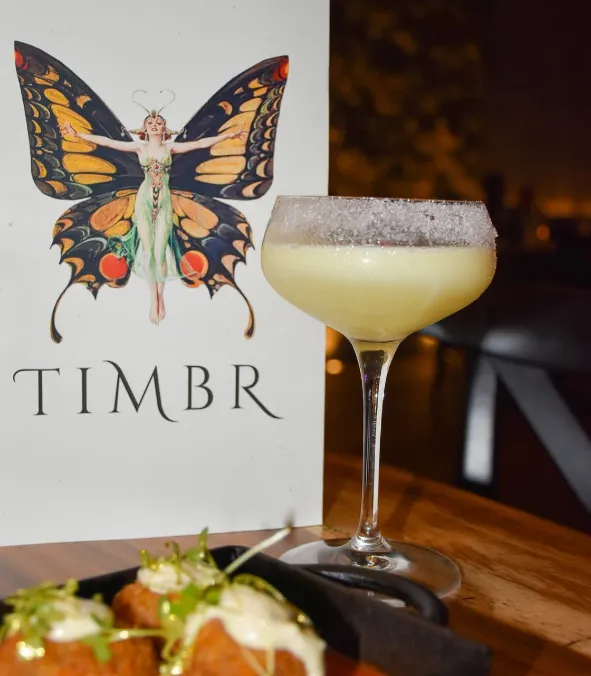
Michael Tronn has spent over three decades mastering the art of "world-building." From New York nightclubs to his latest project, TIMBR, Tronn views hospitality as living theater. In this interview, he explores how intentional design and sensory details create unique dining experiences. We at OysterLink sat down with Michael Tronn to hear his story.
Could you please introduce yourself and tell us a bit about your career path?
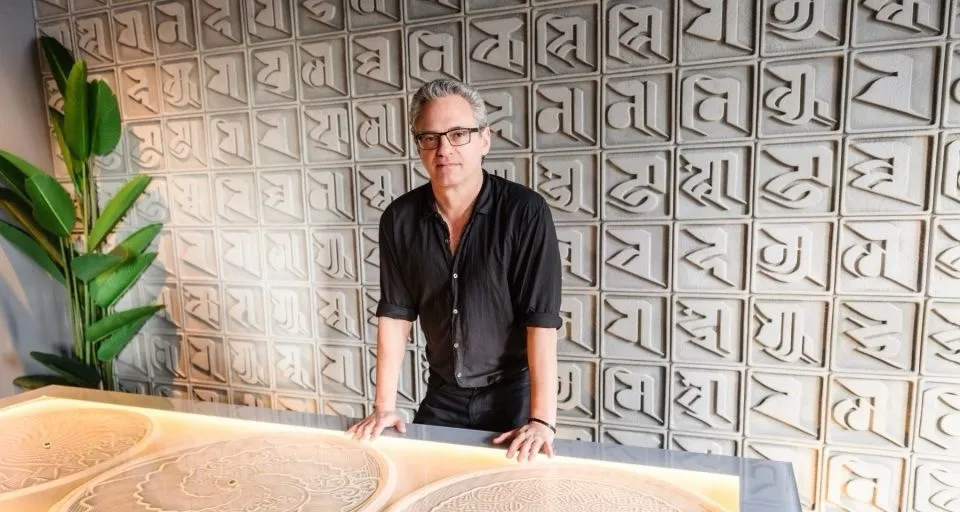
Michael Tronn: I've been doing experiential creation for 33 years, 34 years. It began in New York when I was a teenager, and it has continued ever since. I did 10 years in New York, 8 years in Miami, and several years in production for TV and film in Los Angeles. And then I recently returned to Florida, to Fort Lauderdale, to do a big project here called TIMBR.
You said it began when you were a teenager. Can you tell me more about that?
Michael Tronn: When I was 16, I was going to a special high school called the Guardia High School, which, for anyone who remembers the movie Fame, it's a school, it was that school. And you had to declare a major, or get accepted into a major. And I was accepted for the visual arts.
Within the visual arts context, one of the offerings for elective classes was fashion design. And I took it, I took part one and then I took part two and then my thesis, since I was already going to a lot of nightclubs in the city at the time, I asked the teacher if I could do a thesis project, which would be to hold a show in one of the clubs that I frequented and then videotape it and present it to the class and she said yes. And that show went extremely well, and because it went so well, I was invited to do shows at several other nightclubs.
So the first four events that I did were one at String Fellows, then The Saint, then 1018, and then Tunnel. And then at Tunnel, I met a gentleman named Rudolph, who was a very well-known club impresario. He did Dance Eteria, Tunnel, and Mar,s and a lot of the more well-known clubs in New York during that time period.
And he was a great visionary. And he said to me, there were no promoters at this time or anything like that. And he said, I will pay you to have parties. And as a 17-year-old, I thought, that's a great job. And even by today's standards, it would have been considered fairly high-paying for events.
And that's how I started. I wouldn't have even called it professional then, but that's how I started getting paid to do events in New York. And I would do them at the Tunnel in New York City, on average, once a week or once every other week.
What can you tell us about the new project in Florida?
Michael Tronn: It is the culmination of thousands of events that I have done since the beginning of my career. So everything that I've learned along the way, which is about how to communicate through experience, how to make people feel certain things by experiential design, and using all the different notes and elements to create a world.
I'm very much all about world-building, and I think that's a very different point of view than a lot of designers that I know, where they just care about the aesthetics. So for me, I'm always looking to do something transportive. And TIMBR is definitely that. Even in our branding, advertising, and marketing strategies, from the first point of contact all the way through arrival and the experience at the venue. And then, you know, even for me, until the end of a memory, which hopefully will be a good memory and hopefully be lifelong. So it's a very, very long relationship, and it's a very long experience because I don't consider the product just food and drink. I consider it to be your emotional response and your memory. That's what we're really in the business of creating.
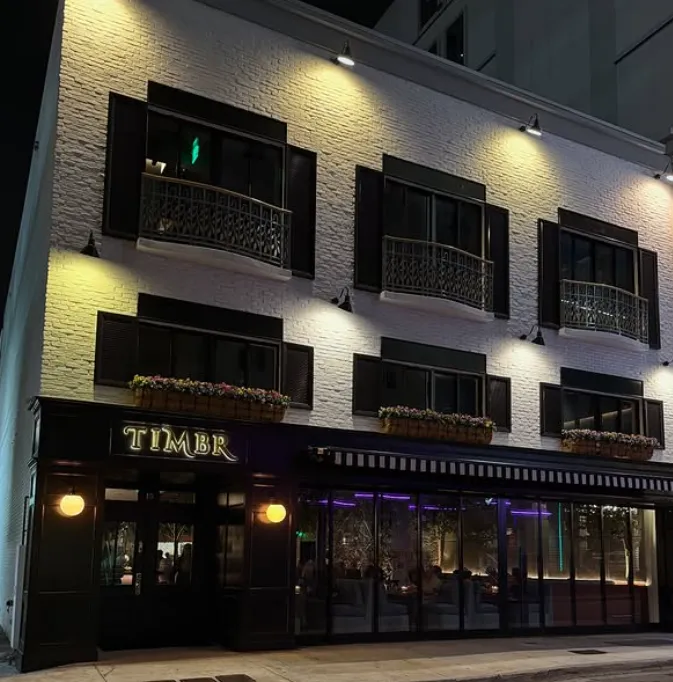
So, TIMBR on the outside, we had a very industrial sort of, I don't want to say rundown, but a hodgepodge of different styles of our building that had occurred over the last 120 years. Because the building is 110 years old. The building was made in 1910. But on the facade, it was just a mess. So I was like, we need to do something unique. But we need to do something familiar.
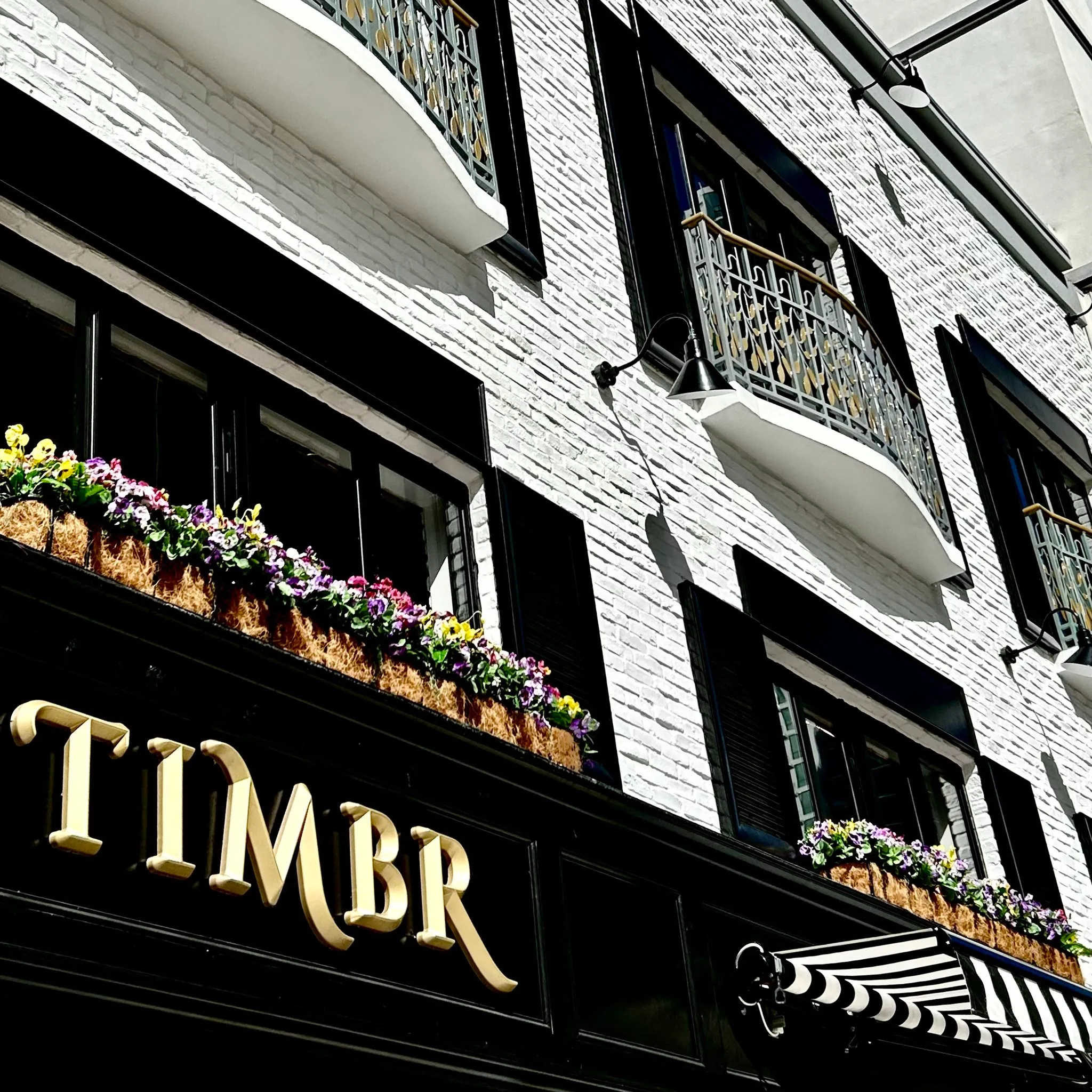
And because TIMBR is all about this warm, enchanted familiarity, the thing that came to mind for me was to do like a European storefront. So we redid the entire front of the building, and on the ground level, it's all black, and it's millwork, and there are these huge terrace windows that the whole front opens on weather-permitting days.
And then above that, there are windows as if it were a little building that you would discover turning a corner in Paris or something. There's, you know, window pots with flowers. And then there are these little Juliette terraces with Art Deco railings. So the whole thing, and every brick on the facade, I didn't want to have sharp edges. I wanted it to be very warm and very inviting, and also look like it had been there for hundreds of years. Or at least a hundred years.
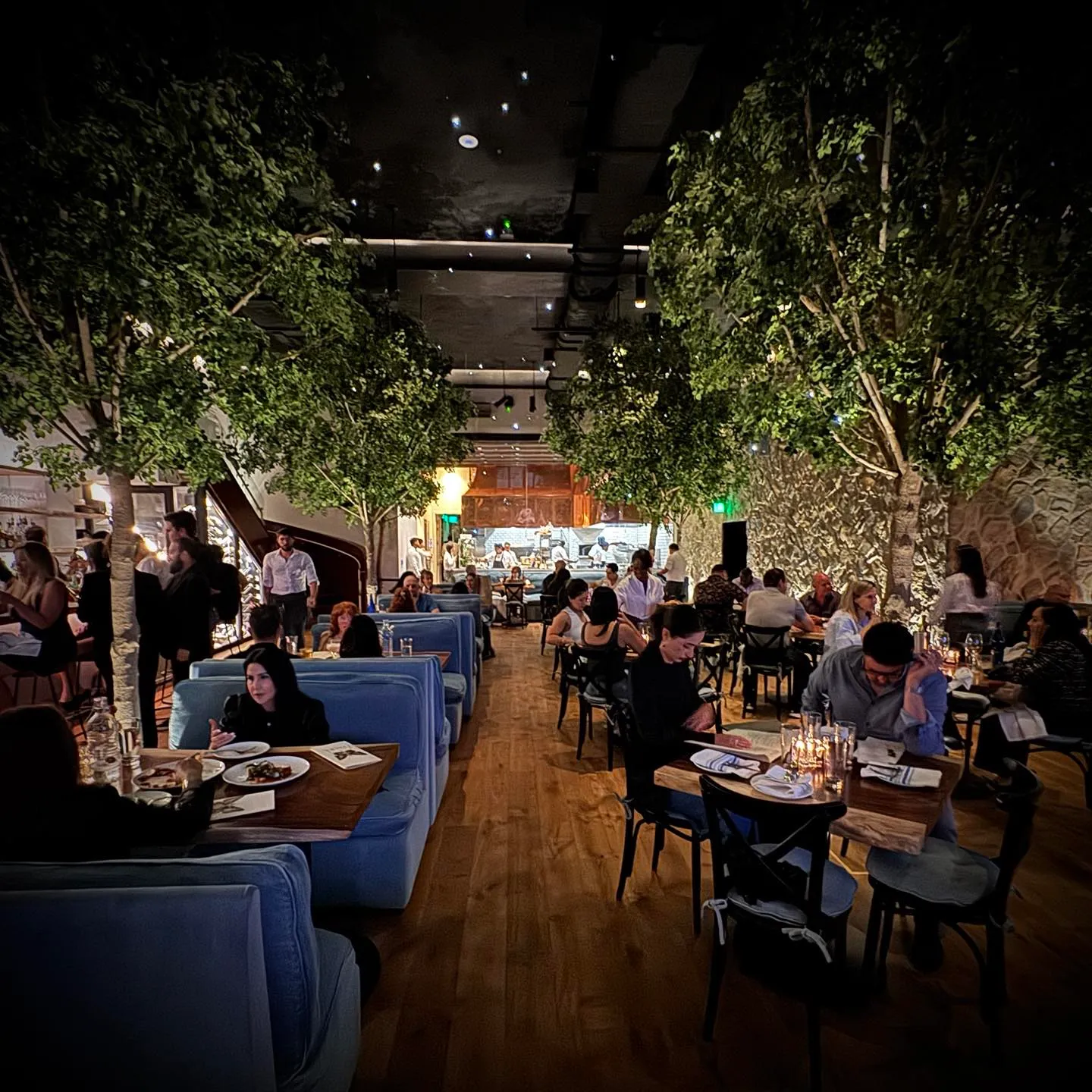
So everything is made to look weathered and authentic. So I designed each brick with a brick mason, and we made the molds for these bricks so that they would meet this criteria of feeling like they were in a pie crust or under, you know, dozens of, let's say, layers of paint to soften them up. Then you go to the place, and it's this incredible high ceiling. It's like a park.
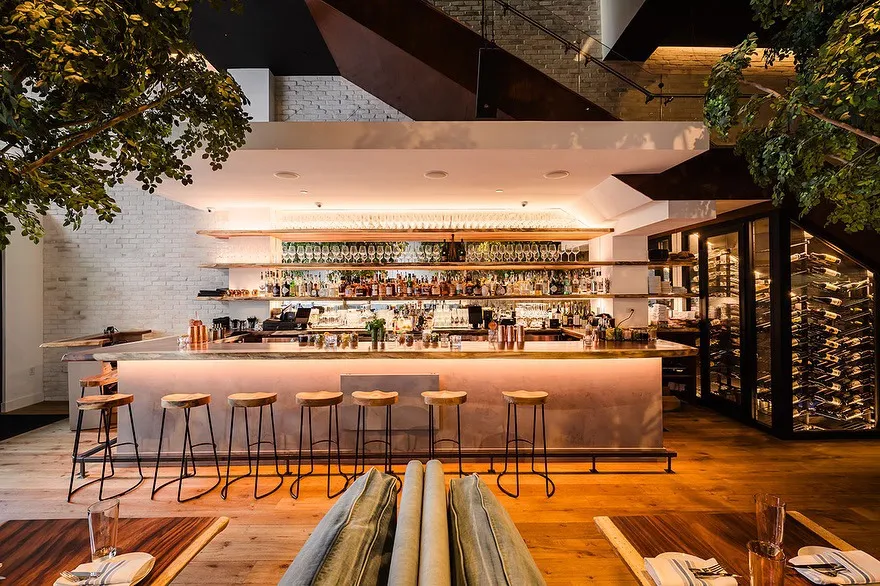
And the name of this front room is actually at the park. So there are nine 15-foot-tall trees. They are real. And then there are these firefly lights hanging. 750 firefly lights were made especially for TIMBR by a friend of mine. All of the tables and all of the banquettes, as well as everything, are custom-made. So all the tables, the bar top, and the bar shelves.
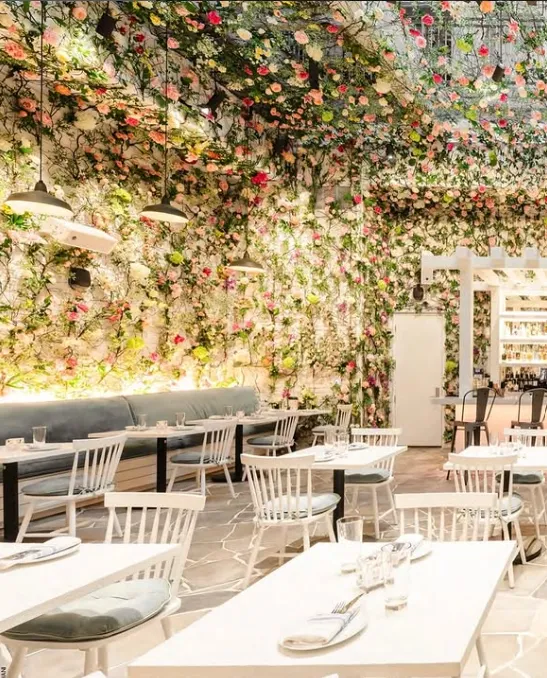
Our live edge monkey pod wood, and there, as you can imagine, is how a room full of live edge tables looks amazing. And then the bank wanted the experience to be elevated as well. So instead of doing a typical hard, not-so-comfortable seating, our bankettes feel more like sofas, and they are, they're upholstered in denim. So we went through six different fill tests to get to the right level of cushioning for all of our banks at seating. And then it's all this aged, beautiful, like wonderful, comfortable, like everybody's favorite pair of old jeans, denim is the upholstery for the whole, for all the dining, for both dining rooms. So that's a big part of the experience. And then the other dining room, which, you know, is very much hidden from the front. It's just like a small corridor.
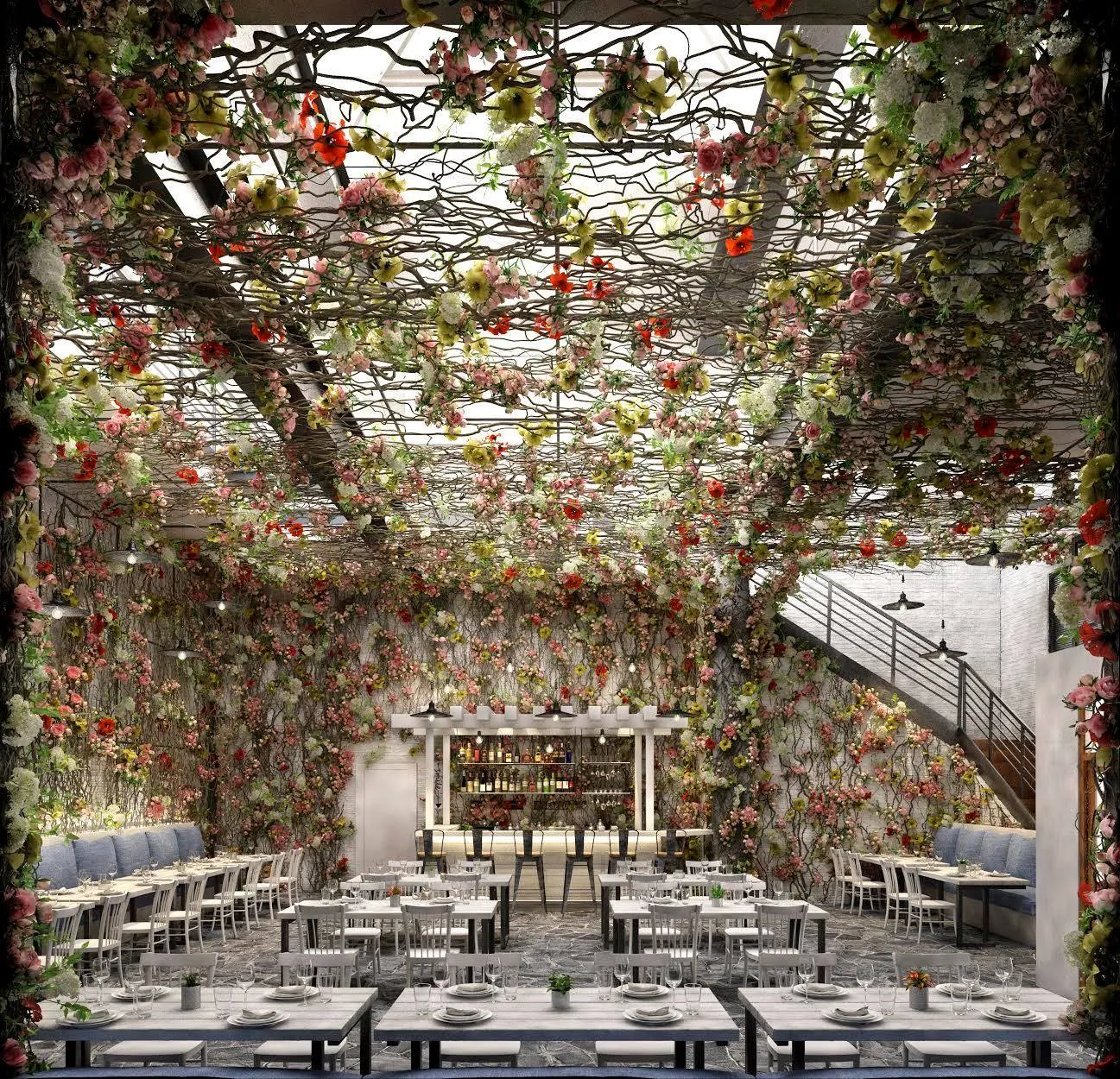
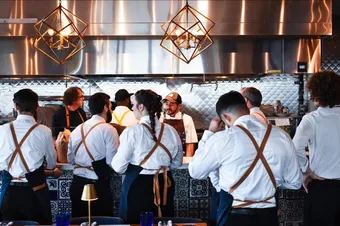
And then you go through it, and you're surprised by this gigantic room with 33-foot high ceilings, and all the walls and the ceiling are covered in 90,000 mostly pink flowers. And it's really, really beautiful. It looks like an outdoor space; there's a glass pyramid, a skylight on top of the whole thing. And it really looks like an enchanted garden. So you have this really great juxtaposition between this beautiful twilight park and this discovery of a magical garden. And then, between the two rooms, is an exposed kitchen meant to look like an estate kitchen. And it has a copper hood and beautiful Heston cooking ranges. They're like in an emerald green, which they have like gold accessories on them. And I had my friend make these beautiful chevron wooden butcher-block countertops for the pass and the cooking island.
And then the brick motif continued into the kitchen as well. So it very much looks like an estate kitchen, not an industrial one. So the whole place is very, very detailed and very intentional. And it fits into the philosophy that I use and have developed, which is the symphony for the senses. Each of these things is a note in an orchestra that communicates to you and is designed to make you feel a certain way.
I'm guessing this is the immersive dining experience; the way TIMBR is described online suggests it is.
Michael Tronn: It's not like a normal restaurant, for sure. It is experiential. It's living theater. So I just feel like it's living theater with food and drinks.
While checking your Instagram account, I noticed that it's clear you've found your inner peace. And in today's terminology, we don't call it inner peace. We call it work-life balance. But hospitality is burnout, stress, and long hours. How did you achieve that?
Michael Tronn: I wouldn't say that I have work-life balance. I would say that my joy is work. So whether it's working to create something like TIMBR or any of the other 18 things that I'm currently working on, some of them are hospitality-based, but some of them are straight-up theatrical. Some of them are literary, and some of them are musical. And I have a whole fine art career that is concurrent with this. So I have many outlets for my creativity.
And that is my life. It is my work too, but that is my main focus. I make a little joke sometimes, I say, I don't have any pets, plants, or partners, so I'm good. In TIMBR, I do have a partner, but I mean in life. So I'm able to use my time in a way that gives me the most pleasure, which is creating.
So we can, let's say, take out the balance and call it just like work life.
Michael Tronn: It's just life. It's just life. know, like, my life and my work don't necessarily feel separate. I feel like TIMBR embodies who I am as a human being and as a creative person. So obviously it's incredibly personal. It's not just a job where someone says, " Design something for me.” And, you know, that's it. It's very much a personal reflection of what I believe people want, as well as what I like.
And the most important element, I think, is not even an element, it's a feeling, it's warmth. And people have been very vocal in their observations about that. Really, people who have surprised me with their astuteness and recognition of the intentionality of the experience created are very appreciative of it. It's very nice, actually.
Over the past two years, I've interviewed a lot of chefs and restaurant owners and operators, and all of them have talked about the high turnover rate in this industry as a major source of stress. So I want to know how you handle the turnover rate at TIMBR.
Michael Tronn: Our front-of-house has a very low turnover rate. We have only been open for roughly a year, just 10 months, but we don't have a huge turnover in front of the house staff. So that's really good. Back of the house is a little higher. So the back-of-house turnover isn't something I'm directly involved in, so I can't really speak to it. I know that working in a kitchen is incredibly hard. I haven't even watched the bear because I turned it on for 15 minutes and was so stressed out about it. I was like, I can't have this in my house. It's already enough, you know, in the place. Yeah, fortunately, that is outside of my purview.
What about the front of house? You said that you have a low turnover rate. How do you manage that?
Michael Tronn: Yeah. Oh, well, I think there are a few major things. Mean, you know, obviously everybody is there, and they are working for money. So because we're as popular as we are, they are doing very well, particularly given, I would say, compared to other restaurants in Fort Lauderdale. We are in the top, certainly in the top 10, and maybe even in the top five.
I know that we, you know, we do sell out regularly and usually a few weeks in advance. So they're doing great. And I think that's a really good reason for front-of-house staff to stay. In addition, they're all really nice people, and they get along with each other and with management.
They do a good job, and every time I have dinner at TIMBR with friends, they always comment on the warmth, friendliness, and ease of the staff. And it is meant to be relaxed with good service. They are not held to an impersonal standard of service where they don't get to be who they are, which I definitely feel is a very normal way that restaurants work, where it takes the personality of the staff out, and then they're just serving. At TIMBR, I feel like we very much have the staff's personality front and center, and they're also really good personalities. So I think it's a good place for everyone, it's comfortable, and it pays well.
What gets someone fired right away from the front-of-house at TIMBR?
Michael Tronn: That is a very good question, and I might not know the answer because I do not do that. I mean stealing, fighting, and the usual stuff.
Then what gets someone hired right away?
Michael Tronn: I think the normal things. So, where they've worked before, of course, and how long they've stayed there, but then definitely character.
Do you think this is more important than experience, or is it equally important?
Michael Tronn: I think they're the same, but I think you can teach people to serve well, I think if you have to, but you can't teach character. So if I were judging character versus service ability, I would probably say character. It's like, maybe it's a 60-40? So I would put the character a little further ahead, but yeah, that's what I would say, actually.
What about tipping? What's your take on tipping?
Michael Tronn: We've experienced both styles. So, one, we did an auto-grad, and then we eliminated it. So I think there's more incentive for excellence without auto grad. And I think, I think it's what I grew up with. So it's what I'm more accustomed to. I feel like in other countries, auto-grad is more common, but I also think the workmanship is different in other cultures. So I think for America or for the United States, thinking standardized, letting the customer decide what they want to do is appropriate.
You just talked about all the effort you put into building these worlds for guests. And recently, everyone has been talking about AI. Do you think AI could actually take over hospitality jobs in the near future?
Michael Tronn: Sure, I think it can take over certain things, but it can't take over what we're talking about. It certainly isn't to the point where it can interpret cultural trends and respond with design to sort of be the yin-yang to those trends. Think AI is very smart, and I use it for lots of things, but I don't think it's a designer.
It can make nice art on its own, but I think one thing that I do run into, even in my best AI moments, is that there is a lack of nuance. I think the hospitality is all nuance, or at least if it's done well. This is where the world is economically, like these are the circumstances we're dealing with. Give me a design. I think it would give me a design. I don't know that it would provide TIMBR for me. I have not tried using it the way I just described. Now I'm going to be curious, but I do not think so until they can. Right now, we're still giving it information, right? So if and when AI is mobilized, with robotics, and it can interpret what it sees and actually have enough memory to take it all in, perhaps it will be able to have more of a human-like response for theatrical design or any kind of art or creative application.
Are you planning to use AI at TIMBR?
Michael Tronn: Well, we'll use it to the degree that it can function. So we use it to answer the phones when we're not there, and even sometimes when we are. We use it, you can use it to create strategies or plans that you would normally have, I mean, that I would normally have done on my own. I mean, I've been doing marketing strategies for decades, so it's not really a major revolution for me to do a marketing strategy.
But if I say to a language model, this is what I'm going to do. Give me your thoughts, or give me some supplementation or whatever. It can do that. When I use it for design work, I have not seen it do. I'm frequently disappointed. Let's put it that way.
Let me wrap up this conversation by asking you what's next for TIMBR?
Michael Tronn: Now we're starting our second season, so it's TIMBR 2.0. So TIMBR 2.0 has a new menu and a new craft cocktail program that's going to be the most robust in the whole area. We do have a new chef. We do have new management, so we have a lot of areas where we are going to raise our standards, which I really like.
And then, in terms of expansion, that was always the plan for TIMBR and for this company: to create multiple concepts in multiple locations. And it's something that I definitely think about all the time, both for TIMBR and also not for TIMBR for other things, because TIMBR was only one of 1300 ideas that I came up with before deciding to do this with my two partners at the time. So when we had our empty space, it was a blank canvas, and I shared 1300 ideas with them; this was the one we all liked. So I think TIMBR could expand, and I think there's room for lots of other theatrical experiences, hospitality, and destinations to exist.
Check Our Career Growth Tools


What would be the next destination?
Michael Tronn: I think Vegas would be really fun because it would be like TIMBR on steroids. I think it could be a lot bigger. It's still pretty big. I mean, we see the 120, but we could go bigger and go even more immersive in a city like Las Vegas. I think Dubai also would lend itself to that. London has a lot of very theme-driven restaurants as well.
Check out more interviews like this brought to you by OysterLink to learn about the industry. You can get them straight to your email by creating an OysterLink account and joining our newsletter.


Loading comments...