


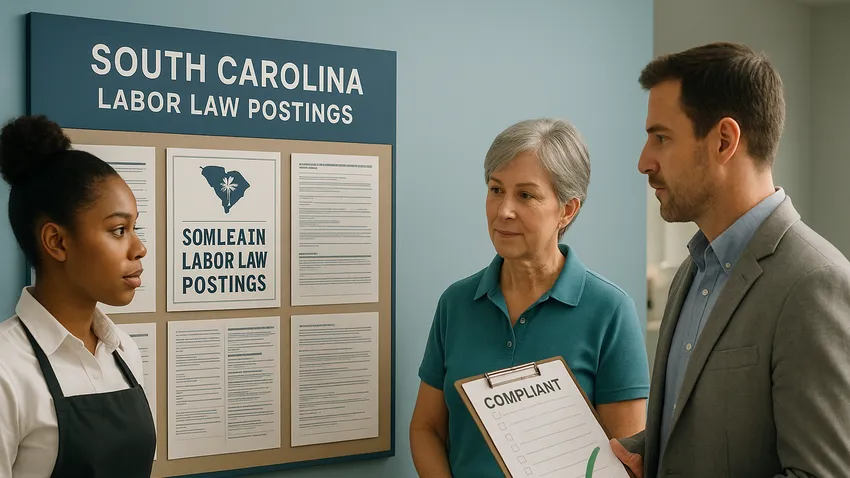

This guide to South Carolina labor law posters explains the mandatory workplace notices South Carolina employers must display to inform employees of their legal rights.
This guide covers which state and federal posters are required, where to place them, how to obtain current versions, and penalties for non compliance.

1. Required Posters Overview
South Carolina Employers must display a set of state and federal labor law posters in conspicuous locations accessible to all employees.
These posters inform workers about safety, wage rules, unemployment benefits, workers compensation, discrimination protections, and other core workplace rights.
State Mandated Posters
The South Carolina Department of Labor, Licensing and Regulation provides a primary LLR Workplace Poster that bundles several state notices.
The LLR Workplace Poster includes Occupational Safety and Health information, a labor law abstract covering the Payment of Wages Act, and Child Labor rules.
Employers must also display the Right to Work poster that explains employees cannot be denied employment based on union membership status.
Additional State Agency Posters
Other required state posters include the Unemployment Insurance Notice and the Workers Compensation Notice.
The South Carolina Human Affairs Commission issues the Employment Discrimination notice that must be visible to employees and applicants.



The Fastest Growing
Restaurant & Hospitality Job Platform
Looking for top paid jobs? Or Hiring for your business?
2. Required Federal Posters
South Carolina employers must also display federal posters that apply nationwide.
Key federal posters include the FLSA Minimum Wage poster, the FMLA poster, the EEO poster, and the Employee Polygraph Protection Act poster.
Federal posters are available free from the U.S. Department of Labor and should match the official agency versions.
3. Where To Place Posters
Posters must be in conspicuous locations where employees can view them during the workday.
Typical placement sites are break rooms, lunchrooms, near time clocks, and other employee common areas.
If a business operates in multiple buildings or remote sites, a full set of required posters should be displayed at each worksite.
Posters must remain unobstructed, legible, and in good condition at all times.
4. Obtaining and Updating Posters
Download the official LLR Workplace Poster in legal or letter size from the South Carolina LLR website.
State agencies provide their required notices as PDFs for free download from their respective sites.
Federal posters are available on the U.S. Department of Labor poster page and must be the current versions issued by the agency.
Keep a routine to check for poster updates and replace any outdated notices immediately.
Format and Consolidated Poster Options
Many employers use consolidated poster displays that combine state and federal notices on a single board for convenience.
When using a consolidated poster, ensure the text and content exactly match the official government versions and are readable at normal viewing distances.
5. Specific Poster Details Employers Should Note
The LLR Workplace Poster specifically includes OSHA information that summarizes workplace safety rights and reporting procedures under South Carolina's standards.
The Labor Law Abstract section explains wage payment timing, allowable deductions, and child labor restrictions employers must follow.
The Right to Work poster clarifies that union membership cannot be required or used as a basis for employment decisions in South Carolina.
Workers Compensation and Unemployment Insurance notices explain how to report workplace injuries and how unemployment benefit claims work.
The Employment Discrimination poster from SCHAC outlines protected categories and provides contact information for filing complaints.
The Fastest Growing
Restaurant & Hospitality Job Platform
Looking for top paid jobs? Or Hiring for your business?
6. Consequences of Non Compliance
Failure to display required posters can lead to fines and penalties from state or federal agencies.
Non compliance can also increase the risk of liability in employment disputes and may trigger broader agency inspections.
Maintaining current posters is a low cost compliance step that reduces regulatory and legal exposure.
7. Best Practices To Stay Compliant
Assign a compliance owner such as an HR manager or business owner to oversee poster maintenance.
Create a master checklist of required state and federal posters and record where each set is displayed.
Inspect posting locations periodically and document the condition and posting date to show proactive management during audits.
Sign up for updates or periodically review the South Carolina LLR and federal labor poster pages for revisions.
8. Quick Reference Table of Posters and Sources
| Poster | Issuer | Where To Obtain and How To Display |
|---|---|---|
| LLR Workplace Poster (OSHA, Labor Law Abstract, Child Labor) | South Carolina Department of Labor, Licensing and Regulation (LLR) | Download free from the LLR website; post where employees congregate |
| Right to Work Poster | South Carolina State Law / LLR | Available from LLR; display alongside other required state notices |
| Unemployment Insurance Notice | South Carolina Department of Employment or LLR | Download from state unemployment page; post in break rooms or near time clocks |
| Workers' Compensation Notice | South Carolina Workers' Compensation Commission | Obtain from WCC website; post where employees can read it easily |
| Employment Discrimination Notice | South Carolina Human Affairs Commission (SCHAC) | Download from SCHAC; display in areas visible to employees and applicants |
| FLSA, FMLA, EEO, EPPA Posters | U.S. Department of Labor and federal agencies | Free from the U.S. Department of Labor poster page; include with state posters |
9. Additional Resources For Posters and Forms
- South Carolina Department of Labor, Licensing and Regulation (LLR)
- South Carolina Workers' Compensation Commission
- South Carolina Human Affairs Commission Poster Resources
- U.S. Department of Labor Poster Page
South Carolina Labor Law Posters: Conclusion
Maintaining current and visible labor law posters is a straightforward compliance action for South Carolina employers.
Assign responsibility, obtain official copies from government agencies, replace outdated notices promptly, and document your posting program to reduce the risk of fines and improve workplace transparency.





Loading comments...