


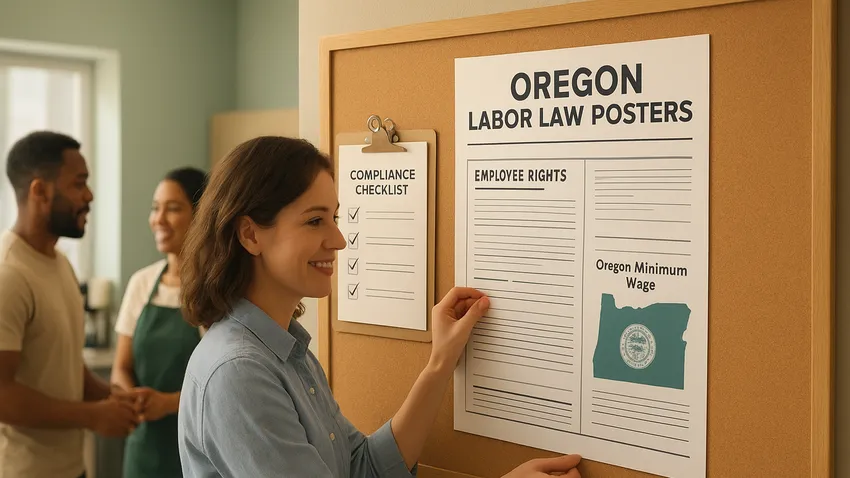

This guide to Oregon labor law posters explains the state and federal workplace notices Oregon employers must display to keep employees informed of their rights.
This resource covers which posters are mandatory, where to place them, how to get current versions, and practical tips for staying compliant.

1. Overview of Required Posters
Oregon employers must display specific state and federal posters in conspicuous locations where employees can easily read them.
Required notices cover minimum wage, paid leave, workplace safety, workers' compensation, anti discrimination, and other core employment protections.
Mandatory Oregon State Posters
Oregon requires a set of state posters issued mainly by the Bureau of Labor and Industries, the Employment Department, Paid Leave Oregon, Oregon OSHA, and the Workers' Compensation Division.
Key state postings include the Oregon Minimum Wage, OFLA, Breaks and Overtime, Equal Pay, Protections for Victims, Paid Leave Oregon, Workplace Accommodations, Safety and Health Protection, Workers' Compensation Notice of Compliance, and the Unemployment Insurance Notice (Form 11).
Mandatory Federal Posters
In addition to state notices, employers must display federal posters such as the Federal Minimum Wage, Employee Polygraph Protection Act, FMLA for covered employers, and the Equal Employment Opportunity notice where applicable.
Which federal posters apply depends on employer size and covered operations, so check federal agency guidance for thresholds.



The Fastest Growing
Restaurant & Hospitality Job Platform
Looking for top paid jobs? Or Hiring for your business?
2. Where To Place Posters
Posters must be placed in conspicuous locations accessible to all employees during the workday.
Typical locations are break rooms, lunchrooms, near time clocks, by HR offices, or other high traffic employee areas.
If your business has multiple worksites, each location generally needs its own set of required posters.
For remote workers, employers must provide required notices electronically or by mail so offsite staff receive the same information.
3. Obtaining and Maintaining Posters
Employers can download free, current state posters from BOLI, the Employment Department, Paid Leave Oregon, Oregon OSHA, and the Workers' Compensation Division.
BOLI also offers a composite poster that combines several required notices into a single display for convenience.
Many posters are available in multiple languages; post them in the language(s) understood by your workforce when appropriate.
Keep posters legible and unobstructed and replace any outdated versions immediately after agencies issue updates.
Paid Leave Oregon Requirements
Paid Leave Oregon became effective January 1, 2023, and employers must display the Paid Leave Oregon poster at each worksite.
Employers must also provide the notice electronically or by mail to remote employees and may access multiple language versions on the Paid Leave Oregon site.
Workers' Compensation Notice of Compliance
After an employer purchases workers' compensation insurance, the Workers' Compensation Division issues a Notice of Compliance following receipt of the insurer's Guaranty Contract.
Employers should post the Notice of Compliance where employees can see it and keep documentation of the notice on file.
The Fastest Growing
Restaurant & Hospitality Job Platform
Looking for top paid jobs? Or Hiring for your business?
4. Language and Remote Worker Considerations
Oregon agencies provide many posters in Spanish and other languages to help employers meet workforce needs.
If employees primarily speak a language other than English, post translated notices or ensure employees receive equivalent written notices they can understand.
Remote staff must be given required notices electronically or by mail, and employers should log delivery methods to show compliance.
5. Consequences of Non Compliance
Failing to display required posters or keeping outdated versions can result in agency enforcement actions, fines, or administrative penalties.
Non compliance can also weaken an employer's position in employment disputes and prompt broader agency audits of wage, hour, or safety practices.
To avoid issues, replace posters when agencies update them and confirm all worksites and remote employees have received required notices.
6. Best Practices For Staying Compliant
Assign a compliance owner such as an HR manager or business owner to monitor posting requirements and updates.
Keep a checklist of required state and federal posters and note which locations have a posted set.
Perform periodic inspections and document poster condition and update dates to show proactive maintenance during audits.
Subscribe to agency mailing lists or frequently check the official pages for BOLI, Oregon OSHA, the Employment Department, and Paid Leave Oregon for new releases.
7. Quick Reference Table of Posters and Sources
| Poster | Issuer | Where To Obtain / How To Display |
|---|---|---|
| Oregon Minimum Wage Poster | Bureau of Labor and Industries (BOLI) | Download from BOLI; update annually on July 1 and post in employee areas |
| Paid Leave Oregon Poster | Paid Leave Oregon | Required at each worksite and provided electronically or by mail to remote workers; available in multiple languages |
| Breaks and Overtime Poster | Bureau of Labor and Industries (BOLI) | Obtain from BOLI and post where employees congregate |
| Workplace Safety and Health Protection | Oregon OSHA | Available in English and Spanish from Oregon OSHA; post prominently |
| Workers' Compensation Notice of Compliance | Workers' Compensation Division | Issued after insurer files Guaranty Contract; post upon receipt |
| Unemployment Insurance Notice (Form 11) | Oregon Employment Department | Automatically mailed after account setup; post where employees can view it |
8. Additional Resources For Posters and Forms
- Bureau of Labor and Industries (BOLI)
- Oregon Occupational Safety and Health Administration (OSHA)
- Workers' Compensation Division
- U.S. Department of Labor
- Equal Employment Opportunity Commission (EEOC)
Oregon Labor Law Posters: Conclusion
Keeping current posters displayed at each worksite and providing notices to remote employees is a straightforward way to meet Oregon posting requirements.
Assign responsibility, download official copies from state and federal agencies, update promptly when laws change, and document your efforts to reduce legal risk and keep employees informed.





Loading comments...