


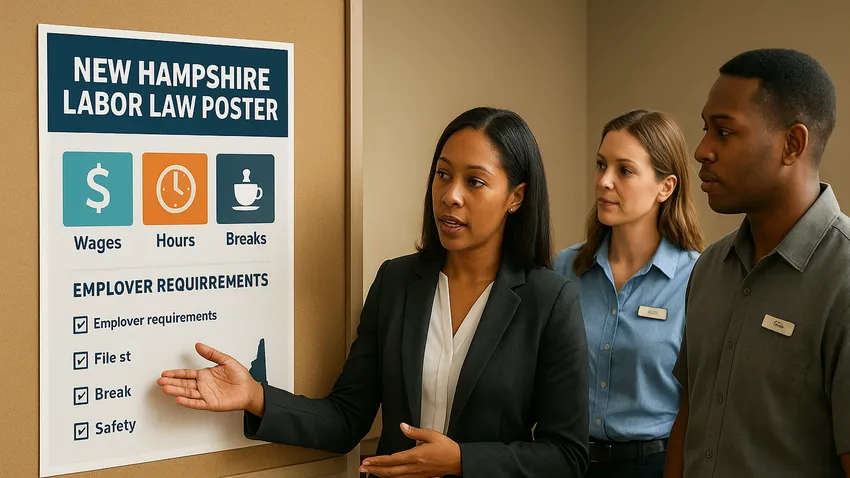

This guide to New Hampshire labor law posters explains the mandatory workplace notices New Hampshire employers must display to inform employees of their legal rights.
This guide covers which federal and state posters are required, where to place them, how to obtain updated versions, and steps to maintain posting compliance.

1. Overview of Required Posters
New Hampshire employers must display a set of state posters along with required federal posters in conspicuous locations accessible to all employees.
These notices cover minimum wage, discrimination protections, workplace safety, unemployment benefits, whistleblower protections, pay equity, and other core labor laws.
Mandatory New Hampshire State Posters
New Hampshire has its own set of mandatory postings that supplement federal notices.
Required state posters include Minimum Wage, Protective Legislation, Employment Discrimination, Unemployment Notice, Whistleblowers' Protection Act, Worker's Right to Know Act, Equal Pay, Employee or Independent Contractor guidance, and Veterans' Benefits and Services.
The Employment Discrimination poster has been updated in many jurisdictions to explicitly include protections such as gender identity.
Mandatory Federal Posters
In addition to state posters, employers must display federal notices issued by national agencies.
Key federal posters required in New Hampshire include Equal Employment Opportunity, Fair Labor Standards Act, Family and Medical Leave Act, OSHA workplace safety, Employee Polygraph Protection Act, and USERRA protections for service members.



The Fastest Growing
Restaurant & Hospitality Job Platform
Looking for top paid jobs? Or Hiring for your business?
2. Where To Place Posters
Posters must be placed in conspicuous locations where employees can read them during the workday.
Typical placement sites include break rooms, lunchrooms, near time clocks, personnel offices, and other common employee areas.
If your business operates multiple locations or remote sites, a full set of posters should be displayed at each worksite where employees report to work.
Posters must remain unobstructed, legible, and in good physical condition at all times.
3. Obtaining and Maintaining Posters
Employers can obtain official New Hampshire posters from the New Hampshire Department of Labor and federal posters from the U.S. Department of Labor and other federal agencies.
Many businesses purchase consolidated poster sets from commercial vendors for convenience, but the content must match the official government versions exactly.
Regularly review posters to ensure they reflect current law because statutes and required language can change.
Replace outdated posters immediately when agencies publish revised versions to avoid posting violations.
Language and Digital Accessibility
If a significant portion of your workforce speaks a language other than English, provide posters in that language to ensure comprehension.
For remote employees, provide digital copies or place official notices on the company intranet so all workers have access to required information.
4. HR and Compliance Responsibilities
Assign an HR manager or business owner to monitor poster requirements and updates.
Keep a master checklist of required federal and state posters and document where each set is posted.
Conduct periodic inspections and record the date and condition of posters to demonstrate proactive maintenance during audits.
The Fastest Growing
Restaurant & Hospitality Job Platform
Looking for top paid jobs? Or Hiring for your business?
5. Consequences of Non Compliance
Failure to display required and current posters can result in fines and enforcement actions from state or federal agencies.
Beyond monetary penalties, non compliance can weaken an employer's position in employment disputes and may trigger broader investigations into wage and hour or safety practices.
6. Best Practices For Staying Compliant
Subscribe to agency mailing lists and periodically check the New Hampshire Department of Labor and U.S. Department of Labor sites for updates.
Maintain both physical posters at worksites and digital versions accessible to remote staff.
Train Managers and Supervisors to recognize when posters need replacing and to report changes promptly to the compliance owner.
Document each poster update with the date and source to show due diligence in the event of an audit.
7. Quick Reference Table of Posters and Sources
| Poster | Issuer | Where To Obtain/How To Display |
|---|---|---|
| Minimum Wage Law | New Hampshire Department of Labor | Download from the NH Department of Labor; post where employees congregate |
| Protective Legislation Law | New Hampshire Department of Labor | Available from the state labor site; display with other state notices |
| Employment Discrimination | New Hampshire Commission for Human Rights / EEOC | Obtain from state or EEOC sites; ensure updated language including gender identity |
| Unemployment Notice | New Hampshire Employment Security | Get from NHES; post where employees can find claim filing information |
| Worker's Right to Know Act | New Hampshire Department of Labor | Provide in work areas where hazardous substances are used; supplement with safety data sheets |
| Equal Pay | New Hampshire Department of Labor | Post where employees can view it; use to support pay equity policies |
| EEO and FLSA | U.S. Department of Labor and EEOC | Free federal posters available online; post with state notices |
| OSHA Workplace Safety | Occupational Safety and Health Administration | Display where safety notices are accessible; keep injury reporting information posted |
| USERRA and EPPA | U.S. Department of Labor | Obtain from federal sites; post with other federal required notices |
8. Additional Resources For Posters and Forms
- New Hampshire Department of Labor
- U.S. Department of Labor
- Equal Employment Opportunity Commission (EEOC)
- Occupational Safety and Health Administration (OSHA)
- New Hampshire Employment Security (NHES)
New Hampshire Labor Law Posters: Conclusion
Keeping required posters current and visible is a straightforward way for New Hampshire employers to meet legal obligations and inform employees of their rights.
Assign responsibility for poster maintenance, obtain official copies from government agencies, provide translations when needed, and document updates to reduce the risk of fines and legal exposure.





Loading comments...