


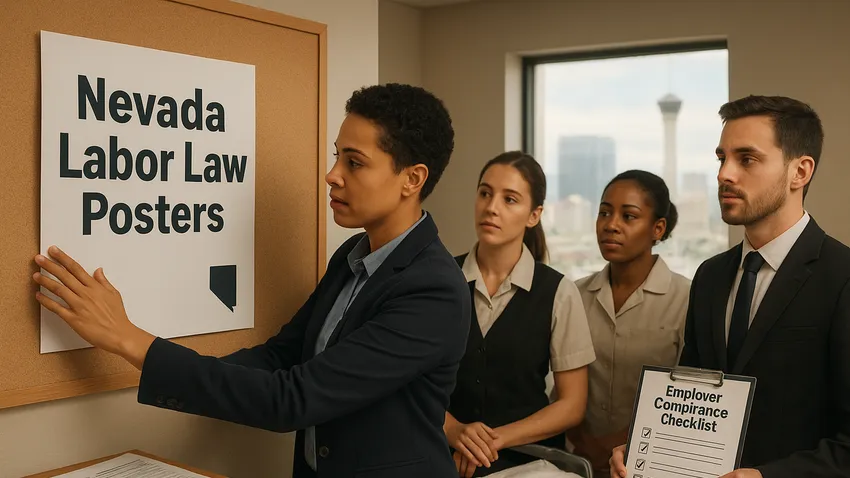

This guide to Nevada labor law posters explains the workplace notices Nevada employers must display to inform employees of their legal rights.
This guide outlines which state and federal posters are required, where to place them, how to keep them current, and penalties for non compliance.

1. Overview of Required Posters
Nevada Employers must post specific state and federal labor notices in conspicuous locations where all employees can read them.
The postings advise workers about minimum wage, overtime, safety, discrimination protections, leave rights, unemployment, and workers compensation.
Mandatory Nevada State Posters
Nevada requires a number of state specific posters that must be displayed at every worksite accessible to employees.
Key state postings include "Rules to Be Observed by Employers" and the "Minimum Wage Bulletin" that outlines current wage rates.
The "Daily Overtime Bulletin" explains overtime pay rules for eligible employees.
The "Notice of Limitations Affecting the Application of Lie Detector Tests" informs employees about limits on polygraph use.
The "Domestic Violence and Sexual Assault Victim's Leave Bulletin" explains leave protections for qualifying victims.
"Domestic Worker's Rights" highlights protections for household employees.
Legislative postings such as AB 190 and AB 307 must be displayed when applicable to explain family medical leave provisions and job training program information.
State versions of "OSHA Safety and Health Protection on the Job", "Unemployment Insurance", "Workers' Compensation", and "Paid Leave" are also required.
Mandatory Federal Posters
In addition to Nevada notices, federal posters are required in Nevada workplaces.
Federal postings commonly required include the Fair Labor Standards Act notice covering minimum wage, overtime, and child labor rules.
The Equal Employment Opportunity poster explains non discrimination protections under federal law.
The Family and Medical Leave Act poster must be displayed where eligible employees can learn about FMLA rights.
The federal OSHA job safety poster is required for most employers to communicate workplace safety standards.



The Fastest Growing
Restaurant & Hospitality Job Platform
Looking for top paid jobs? Or Hiring for your business?
2. Where and How To Display Posters
Posters must be positioned in conspicuous common areas such as break rooms, near time clocks, or other employee gathering points.
If a business has multiple buildings or remote sites, a full set of required posters should be displayed at each location where staff work.
Posters should be unobstructed, legible, and kept in good condition at all times.
If a large share of the workforce reads another language, provide posters in that language to ensure comprehension.
Electronic posting may be acceptable if all employees have reliable access and the employer can demonstrate that the notices are readily available.
3. Obtaining and Updating Posters
Official, printable versions of Nevada and federal posters are available free from government agencies.
The Nevada Labor Commissioner's Office and the Nevada Department of Business and Industry maintain current state posters online.
The U.S. Department of Labor and OSHA provide federal posters that employers can download at no cost.
Many employers purchase consolidated poster displays from vendors for convenience, but the content must match official agency versions.
Check poster sources at least annually and after legislative sessions to ensure the versions you display reflect current law.
Language and Electronic Posting Guidance
If a significant portion of your workforce speaks a language other than English, post translated versions alongside the English notices.
Electronic posting can be used where permitted, but employers should document access methods and ensure every employee can view the notices during the workday.
The Fastest Growing
Restaurant & Hospitality Job Platform
Looking for top paid jobs? Or Hiring for your business?
4. Penalties and Risks of Non Compliance
Failing to post required notices can lead to fines, citations, and administrative penalties from state or federal agencies.
OSHA and other agencies may issue citations for missing or out of date notices as part of inspections.
Beyond monetary penalties, lack of proper postings can weaken an employer's position in employment disputes and invite more extensive agency inquiries.
5. Best Practices for Remaining Compliant
Designate a compliance owner such as an HR manager or business owner to track poster requirements and updates.
Maintain a master checklist of required state and federal posters and list the locations where they are posted.
Perform periodic inspections and document the condition and date of each poster to show proactive maintenance if inspected.
Subscribe to updates from the Nevada Labor Commissioner and the U.S. Department of Labor to receive revision notices promptly.
When hiring remote or mobile employees, ensure they have equivalent access to required notices either through onsite postings or electronic access.
6. Quick Reference Table of Posters and Sources
| Poster | Issuer | Where To Obtain/How To Display |
|---|---|---|
| "Rules to Be Observed by Employers" | Nevada Labor Commissioner | Download from labor.nv.gov; post in common employee areas |
| Minimum Wage Bulletin | Nevada Department of Business and Industry | Obtain from state site; update when wage rates change |
| FLSA - Minimum Wage and Overtime | U.S. Department of Labor | Free from DOL; display with state posters where employees can view |
| OSHA - Safety and Health Protection on the Job | OSHA | Download federal and state safety posters; post in visible location |
| Unemployment Insurance and Workers' Compensation | Nevada Labor Commissioner / State Agencies | Available from state sites; post where employees congregate |
7. Additional Resources For Posters and Forms
- Nevada Labor Commissioner
- Nevada Department of Business and Industry - Workplace Poster Requirements
- Required Posters for All Employers - Printable PDF
Nevada Labor Law Posters: Conclusion
Keeping current labor law posters displayed in conspicuous locations is a straightforward way Nevada employers can meet legal obligations and inform employees.
Assign responsibility, obtain official copies from government agencies, update promptly when laws change, and document your efforts to reduce the risk of fines and legal exposure.





Loading comments...