


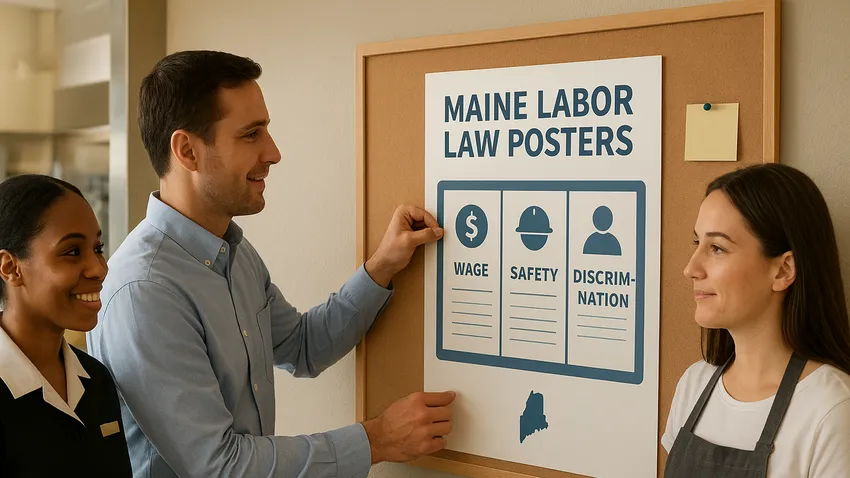

This guide to Maine labor law posters explains the state and federal workplace notices employers must display to inform employees of their rights.
This guide covers which Maine posters are required, where to place them, how to get current versions, and penalties for non compliance.

1. Overview of Required Posters
Maine employers must display specific state and federal labor law posters in conspicuous locations accessible to all employees.
Postings inform staff about minimum wage, anti discrimination protections, workplace safety, workers compensation, child labor rules, and unemployment benefits.
Mandatory Maine State Posters
The Maine Department of Labor issues the core state posters employers must display.
Required state notices include the Minimum Wage Poster and the Workers Compensation Poster that detail employee entitlements and employer responsibilities.
The Whistleblowers Protection Act Poster explains employee protections against retaliation for reporting illegal or unsafe practices.
The Video Display Terminal VDT Poster provides ergonomic guidance for employees who use computer terminals to help prevent repetitive strain injuries.
Public sector workplaces must post Occupational Safety and Health Regulations that describe workplace safety rules specific to public employers.
The Child Labor Poster summarizes laws governing the employment of minors including working hours and prohibited occupations.
The Regulation of Employment Poster covers payment of wages, rest breaks, overtime rules, and other employment standards.
The Sexual Harassment Poster explains prohibited conduct, gives examples, and outlines complaint procedures through the Maine Human Rights Commission.
The Maine Employment Security Act Poster is required for employers who pay unemployment tax and provides information on unemployment benefits.
Mandatory Federal Posters
In addition to state posters, Maine employers must post federal notices issued by U.S. agencies.
Key federal posters include the Equal Employment Opportunity poster, Fair Labor Standards Act poster, Family and Medical Leave Act poster, OSHA workplace safety poster, and the Employee Polygraph Protection Act poster.
Federal posters explain protections against discrimination, federal minimum wage and overtime rules, leave rights, and workplace safety rights.



The Fastest Growing
Restaurant & Hospitality Job Platform
Looking for top paid jobs? Or Hiring for your business?
2. Where To Place Posters
Posters must be placed in conspicuous locations where employees can easily read them during the workday.
Typical locations include break rooms, lunchrooms, time clock areas, near payroll offices, and other high traffic employee areas.
If you operate multiple facilities or remote sites, a full set of required posters must be displayed at each physical location.
Posters should be unobstructed, legible, and kept in good condition at all times.
3. Obtaining and Maintaining Posters
The Maine Department of Labor provides free downloads of required state posters and will mail printed copies by request. Call (207) 623-7900 for assistance.
Federal posters are available from the U.S. Department of Labor website at no cost.
Some employers purchase consolidated wall displays from private vendors for convenience, but the content must match the official government versions exactly.
Regularly check agency websites and sign up for updates so you can replace posters immediately when laws change.
Language and Remote Employee Considerations
Make sure posters are available in languages your workers understand. The Maine Department of Labor offers posters in Arabic, Chinese, French, Portuguese, Somali, and Spanish.
For remote employees provide electronic access to required posters or mail printed copies to remote workers to maintain compliance.
The Fastest Growing
Restaurant & Hospitality Job Platform
Looking for top paid jobs? Or Hiring for your business?
4. Penalties and Enforcement
Maine law requires employers to display these notices and provides penalties for violations under Title 26, section 42-B.
After being notified of a posting violation, employers can face fines of $25 to $100 per day until the poster is posted.
Repeat or prolonged violations can lead to maximum penalties up to $5,000 for ongoing non compliance.
Beyond fines, failure to post required notices can harm an employer in administrative reviews or litigation by undermining defenses about employee notice of rights.
5. Best Practices For Staying Compliant
Assign a compliance owner such as an HR manager or business owner to maintain poster compliance across locations.
Keep a master checklist of required federal and state posters and note where each set is posted in your facilities.
Inspect posting locations periodically, document the date of each inspection, and keep records of poster versions and replacement dates.
Subscribe to the Maine Department of Labor and U.S. Department of Labor mailing lists to receive alerts about new poster versions.
6. Quick Reference Table of Posters and Sources
| Poster | Issuer | Where To Obtain and How To Display |
|---|---|---|
| Minimum Wage Poster | Maine Department of Labor | Free download from the state site; display where employees congregate |
| Whistleblowers Protection Act Poster | Maine Department of Labor | Obtain from Maine DOL; post in break rooms and near time clocks |
| Workers Compensation Poster | Maine Department of Labor | Available from Maine DOL; keep visible and legible |
| FLSA and Federal Employee Rights Posters | U.S. Department of Labor | Download federal posters from dol.gov; include with state posters |
| Sexual Harassment Poster | Maine Human Rights Commission | Post where employees can read it and include complaint contact information |
7. Additional Resources For Posters and Forms
- Maine Department of Labor Posters
- Maine Revised Statutes, Title 26, §42-B
- U.S. Department of Labor Poster Page
- Maine Human Rights Commission
- Occupational Safety and Health Administration (OSHA)
Maine Labor Law Posters: Conclusion
Displaying current state and federal posters in conspicuous locations is a straightforward step that helps Maine employers meet legal obligations and support an informed workplace.
Assign responsibility, obtain official copies, update promptly when laws change, and document inspections to reduce the risk of fines and to demonstrate proactive compliance.





Loading comments...