


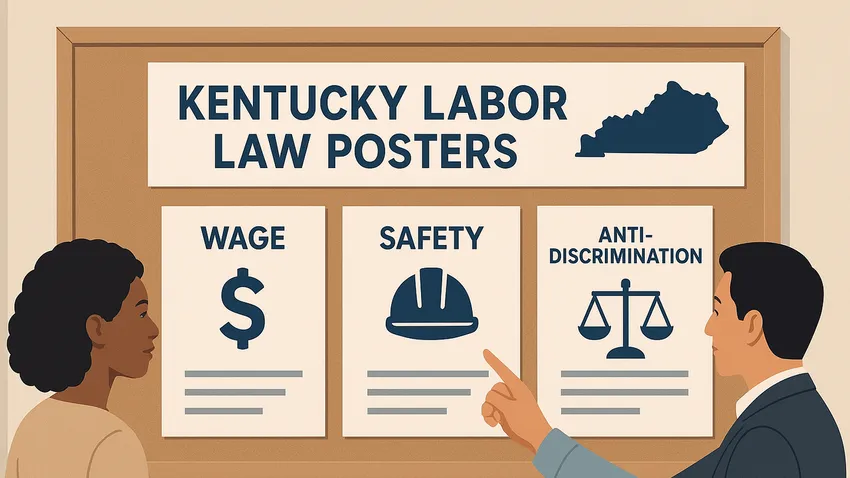

This guide to Kentucky labor law posters explains the mandatory workplace notices Kentucky employers must display to inform employees of their legal rights.
This guide reviews which state and federal posters are required, where to place them, how to obtain current versions, and penalties for non compliance.

1. Overview of Required Posters
Kentucky employers must display both state and federal labor law posters in conspicuous locations accessible to all employees.
These notices inform staff about wage and hour rules, workplace safety, discrimination protections, unemployment benefits, child labor limits, and workers compensation procedures.
Mandatory Kentucky State Posters
The Kentucky Education and Labor Cabinet issues several state specific posters that most employers must display.
Key state posters include Safety and Health on the Job, Wage and Hour, Wage Discrimination Because of Sex, Child Labor Law, Unemployment Insurance Benefits, Equal Employment Opportunity, and Workers' Compensation notice.
Some state posters were recently updated so employers should confirm they have the current version before printing or posting.
Poster Updates and Dates to Note
The Safety and Health on the Job poster was updated in June 2025 and is available in English and Spanish.
The Wage and Hour, Wage Discrimination Because of Sex, and Child Labor Law posters were revised in April 2024.
The EEO notice also received mandatory updates in 2024 to reflect new contact and statutory information.
Unemployment Insurance and Workers' Compensation notices have older revision dates, with unemployment updated in 2012 and workers compensation last revised in 2009, but employers should still download the current files from the state site.



The Fastest Growing
Restaurant & Hospitality Job Platform
Looking for top paid jobs? Or Hiring for your business?
2. Required Federal Posters
In addition to state postings, federal posters must be prominently displayed at the workplace.
Common federal posters include FMLA, federal EEO notice, and the Employee Polygraph Protection Act.
Federal posters are often available in multiple languages and should match the official U.S. Department of Labor versions.
If your workplace hosts applicants or interviews, federal notices should be viewable in the front lobby or interview rooms.
For online hiring, post a prominent notice stating that applicants have rights under federal employment laws and provide links to the federal posters.
3. Where To Place Posters
Posters must be placed in conspicuous areas where employees can read them during the workday.
Common locations are break rooms, lunchrooms, near time clocks, and in human resources or front office spaces.
If you operate multiple facilities or remote worksites, each physical location must display the full set of required posters.
Make sure posters are unobstructed, legible, and kept in good condition.
4. Obtaining and Maintaining Posters
State posters are available at no cost from the Kentucky Education and Labor Cabinet website.
Federal posters can be downloaded free from the U.S. Department of Labor.
Some municipalities such as the Kentucky League of Cities also make required workplace posters available free to local governments and small employers.
Commercial consolidated poster sets are available but must match the exact content of official government releases.
Employers should monitor agencies for revisions and replace outdated posters immediately when new versions are issued.
The Fastest Growing
Restaurant & Hospitality Job Platform
Looking for top paid jobs? Or Hiring for your business?
5. Consequences of Non Compliance
Failure to display required and current posters can result in enforcement actions and financial penalties.
Kentucky authorities may assess fines up to $7,500 per inspection for posting violations in some circumstances.
Beyond fines, lack of proper notices can weaken an employer's position in labor disputes and may prompt broader compliance audits by state or federal agencies.
6. Best Practices For Staying Compliant
Assign a single compliance owner such as an HR manager or business owner to oversee poster maintenance across locations.
Create and maintain a master checklist that lists each required poster, the revision date, and the physical location where it is posted.
Inspect posting areas periodically and document the date and condition of posters to demonstrate proactive compliance during any inspection.
Subscribe to updates from the Kentucky Education and Labor Cabinet and the U.S. Department of Labor to receive alerts about poster revisions.
7. Quick Reference Table of Posters and Sources
| Poster | Issuer | Where To Obtain/How To Display |
|---|---|---|
| Safety and Health on the Job | Kentucky Education and Labor Cabinet / Kentucky OSHA | Download the June 2025 version from the state safety site; display in employee common areas |
| Wage and Hour | Kentucky Education and Labor Cabinet | Obtain the April 2024 version from the state site; post near time clocks or break rooms |
| Wage Discrimination Because of Sex | Kentucky Education and Labor Cabinet | Use the April 2024 notice; ensure visibility to all employees and applicants |
| Child Labor Law | Kentucky Education and Labor Cabinet | Post the April 2024 update in areas where minors are scheduled or hired |
| Unemployment Insurance Benefits | Kentucky Education and Labor Cabinet | Available from the state; post in employee common areas and HR spaces |
| Equal Employment Opportunity (EEO) | Kentucky and Federal EEO Authorities | Display the 2024 updated state EEO notice and federal EEO notice in public employee areas |
| Workers' Compensation Posting Notice | Kentucky Department of Workers' Claims | Post the current notice where employees congregate and in HR files |
8. Additional Resources For Posters and Forms
- Kentucky Education and Labor Cabinet
- U.S. Department of Labor
- Kentucky League of Cities - workplace posters
- Kentucky Chamber - mandatory poster information
- Kentucky OSHA Safety and Health Poster (June 2025)
Kentucky Labor Law Posters: Conclusion
Displaying current state and federal labor law posters in conspicuous locations is a straightforward but essential compliance step for Kentucky employers.
Assign responsibility, obtain official copies from government agencies, monitor updates, and replace outdated posters promptly to reduce the risk of fines and legal exposure.





Loading comments...