


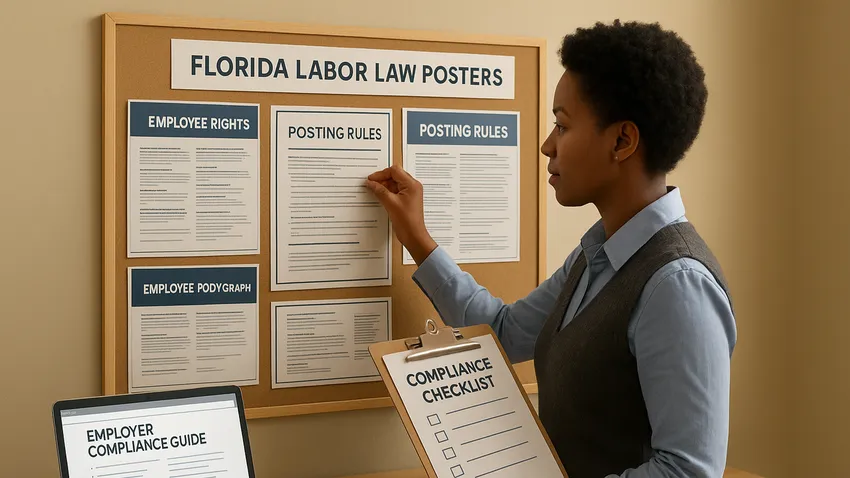

This guide to Florida labor law posters explains the notices employers must display to inform employees of their legal rights under federal and Florida law.
This guide covers which federal and state posters are required, where to post them, how to obtain official copies, and penalties for non compliance.

1. Overview of Required Posters
Florida Employers must display both federal and state labor law posters in conspicuous locations where employees can easily see them.
Postings inform employees about minimum wage, workplace safety, discrimination protections, leave rights, reemployment assistance, workers compensation, and child labor rules.
Mandatory Federal Posters
All Florida Employers must post key federal notices including the Fair Labor Standards Act minimum wage poster and the Equal Employment Opportunity poster.
Other required federal notices include the OSHA "Job Safety and Health: It’s the Law" poster, the Family and Medical Leave Act notice, the Employee Polygraph Protection Act notice, and the USERRA military reemployment rights notice.
Mandatory Florida State Posters
In addition to federal posters, Florida requires state specific notices such as the Florida Minimum Wage notice and the Florida Law Prohibits Discrimination poster.
Florida Employers must also display the Reemployment Assistance Program Law poster, Workers' Compensation notice, and the Florida Child Labor Law poster when hiring minors.
As of September 30, 2025 the Florida minimum wage is $14.00 per hour and the posted notice must reflect the current rate.



The Fastest Growing
Restaurant & Hospitality Job Platform
Looking for top paid jobs? Or Hiring for your business?
2. Where To Place Posters
Posters must be displayed in conspicuous, accessible areas where employees congregate during the workday.
Typical locations include break rooms, near time clocks, employee bulletin boards, and common work areas.
If a business operates multiple sites a full set of required posters should be displayed at each location.
For remote employees electronic posting is acceptable if employees have easy and consistent access to required notices.
3. Obtaining and Maintaining Posters
Federal posters are available free from the U.S. Department of Labor and must be the current versions issued by the agency.
Florida state posters and required notices are available from the Florida Department of Commerce and should be downloaded from official state pages.
Many Employers purchase consolidated poster displays from private vendors for convenience but must ensure the content exactly matches the official government text.
Maintain compliance by checking for updates regularly and replacing outdated posters immediately when agencies publish revisions.
Language and Accessibility Notes
While not always mandatory, Employers should consider posting notices in additional languages commonly spoken by the workforce to ensure comprehension.
Keep posters unobstructed, legible, and in good physical condition to avoid violations during an inspection or audit.
The Fastest Growing
Restaurant & Hospitality Job Platform
Looking for top paid jobs? Or Hiring for your business?
4. Consequences of Non Compliance
Failure to display required posters can result in penalties from federal agencies such as the Department of Labor and from state enforcement bodies.
Non compliance can also harm an Employer’s legal posture in wage, safety, discrimination, or unemployment disputes.
Promptly updating and displaying accurate notices reduces the risk of fines and strengthens an Employer’s position if a complaint arises.
5. Best Practices For Staying Compliant
Assign a compliance owner such as an HR Manager, Business Owner, or designated manager to monitor poster requirements and updates.
Create a master checklist of required federal and state posters and document where each set is posted at every worksite.
Perform periodic inspections to confirm posters remain visible and current and keep dated records or photos as evidence of upkeep.
Subscribe to updates from the U.S. Department of Labor and the Florida Department of Commerce and review Florida Statutes Chapter 448 for statutory changes that affect posting obligations.
Hospitality Employers should ensure roles such as Chef, Bartender, Server, and Event Planner are included in routine compliance communications when notices or rules change.
6. Quick Reference Table of Posters and Sources
| Poster | Issuer | Where To Obtain/How To Display |
|---|---|---|
| FLSA Minimum Wage and Overtime Poster | U.S. Department of Labor | Free from the U.S. DOL; post where employees and applicants can view it |
| OSHA "Job Safety and Health: It’s the Law" | Occupational Safety and Health Administration | Obtain from OSHA; display in common employee area and near safety info |
| Family and Medical Leave Act (FMLA) Poster | U.S. Department of Labor | Download from DOL; ensure visibility to eligible employees |
| Employee Polygraph Protection Act (EPPA) Notice | U.S. Department of Labor | Required for most private Employers; post in employee areas |
| Equal Employment Opportunity (EEO) Poster | Equal Employment Opportunity Commission | Get from EEOC or DOL; post where job applicants and staff can view it |
| Florida Minimum Wage Poster | Florida Department of Commerce | Download official state poster showing current rate ($14.00/hr as of 9/30/2025); post in conspicuous place |
| Florida Reemployment Assistance Program Law | Florida Department of Commerce | Available from state site; post with other employee notices |
| Florida Workers' Compensation Notice | Florida Department of Commerce | Obtain from state; display where employees can easily access it |
| Florida Child Labor Law Poster | Florida Department of Commerce | Required for employers of minors; outline hours and prohibited occupations |
7. Additional Resources For Posters and Forms
- U.S. Department of Labor Workplace Posters
- Florida Department of Commerce - Display Posters and Required Notices
- Florida Statutes Chapter 448
- Florida United Businesses Association Publications
- University of South Florida - Required Labor Posters & Information
Florida Labor Law Posters: Conclusion
Displaying accurate, current federal and Florida posters in conspicuous places is a fundamental compliance step for Employers operating in Florida.
Assign responsibility, obtain official copies from government agencies, update promptly when laws change, and document posting locations and dates to reduce the risk of fines and legal exposure.





Loading comments...