


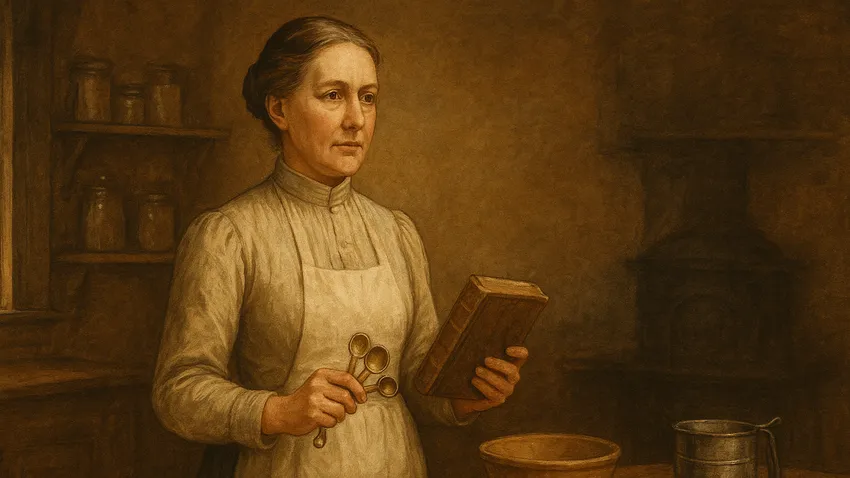

Fannie Merritt Farmer transformed American cooking by bringing scientific precision to the home kitchen. Her 1896 The Boston Cooking-School Cook Book standardized measurements and turned recipes into reliable, teachable instructions for cooks and professional kitchen practice and education.
A pioneer in domestic science, Farmer taught at the Boston Cooking School, opened Miss Farmer's School of Cookery, and lectured on nutrition at Harvard Medical School. Her cookbook sold millions and remains a foundation of American culinary education.

Fannie Farmer's Formal Culinary Training
Fannie Farmer's formal culinary education began when she enrolled at the Boston Cooking School in Boston, Massachusetts, at age 30 after recovering partial mobility from a childhood stroke. She graduated in 1889 and quickly moved into leadership roles.
Farmer was appointed Assistant Director of the Boston Cooking School in 1891 and became Principal in 1894. Her training emphasized scientific method, precise measurement, nutrition, and household management, shaping her approach to teaching and writing.



The Fastest Growing
Restaurant & Hospitality Job Platform
Looking for top paid jobs? Or Hiring for your business?
Fannie Farmer Schools & Businesses
Fannie Farmer translated her teaching philosophy into institutions that taught ordinary people how to cook with consistency and care.
- Boston Cooking School (Student, 1889; Assistant Director, 1891; Principal, 1894) – Where Farmer learned and then taught the principles of domestic science, measurement, and nutrition.
- Miss Farmer's School of Cookery (1902) – Founded after she left the Boston Cooking School, this private school in Boston taught household management, cooking technique, and professional cookery to women and homemakers.
- Boarding House and Teaching Kitchen – Earlier in her career Farmer ran a boarding house known for well prepared meals, an experience that informed her practical approach to feeding families and students.
Through these ventures Farmer professionalized home cooking and created reproducible methods that novices could learn and apply.
Fannie Farmer's Other Ventures
Beyond schools, Farmer extended her influence through writing, lecturing, and consultation.
- Lectures and Teaching: She lectured widely on nutrition and cookery, including presentations at Harvard Medical School where she taught the importance of proper diet for the sick and convalescent.
- Consulting: Farmer advised institutions and taught household management to those responsible for large scale or institutional food service.
- Standardization: Her insistence on precise measurements and tested recipes changed cookbook writing and kitchen instruction across America.
Fannie Farmer Publications and Teaching
Fannie Farmer was a prolific author whose books combined recipes with clear instruction and practical advice for home and institutional cooks.
- The Boston Cooking-School Cook Book (1896) – Farmer's landmark work that introduced standardized measurements and user friendly, tested recipes. It sold millions of copies and went through many revised editions.
- Chafing Dish Possibilities (1898) – A book focused on entertaining and small range cookery.
- Food and Cookery for the Sick and Convalescent (1904) – Practical guidance on nutrition for patients and caregivers.
- Other Works: Including What to Have for Dinner (1905), Catering for Special Occasions (1911), and several popular household guides that emphasized economy, nutrition, and technique.
The Fastest Growing
Restaurant & Hospitality Job Platform
Looking for top paid jobs? Or Hiring for your business?
Fannie Farmer Awards and Accolades
While Farmer lived before the modern system of culinary awards, her recognition came through influence and lasting presence.
- Enduring Cookbook Sales: The Boston Cooking-School Cook Book sold millions of copies in her lifetime and has remained in print in revised editions, a testament to its foundational role.
- Legacy in Education: Her methods became standard in domestic science programs and influenced culinary instruction nationwide.
- Influence on Nutrition: Her work bridging cookery and dietetics helped shape early thinking about food, health, and institutional feeding.
Fannie Farmer Personal Life
Fannie Merritt Farmer was born March 23, 1857, in Boston, Massachusetts, the eldest of four daughters. At 16 she suffered a paralytic stroke that left her temporarily unable to walk and interrupted her formal schooling.
During recovery she developed a deep interest in cookery, running a successful boarding house that showcased her careful, well tested cooking. Later she pursued formal training at the Boston Cooking School and devoted her life to teaching and writing.
Farmer suffered additional strokes later in life and used a wheelchair, yet she continued to write, revise recipes, and lecture until her death on January 15, 1915.
Fannie Farmer Family and Friends
Fannie Farmer never married and had no children. Her primary relationships were with students, colleagues, and the networks she built through teaching and publishing.
Her mentorship and professional friendships helped spread her ideas across schools, hospitals, and households, ensuring her methods endured beyond her lifetime.
Fannie Farmer Chef Profile: Conclusion
Fannie Farmer was not a celebrity Chef in the modern sense but she was a transformational figure in American food. By applying scientific rigor, clear instruction, and reliable measurement to everyday cooking she made good food teachable and repeatable.
Her Boston Cooking School Cook Book set a new standard for recipe writing and kitchen education. Farmers emphasis on nutrition and method shaped domestic science, professional training, and the way Americans cook to this day.





Loading comments...