



Nervous about your next hospitality interview? You’re definitely not alone — lots of people get that pre-interview adrenaline rush, especially for jobs they really want and aren’t sure what to expect.
Here’s some good news: You can get the upper hand by preparing beforehand. This guide will walk you through using AI to prepare for a hospitality interview, but if you’d much rather get ready-to-go templates with existing questions and answers, OysterLink has interview questions and answers for over 40 different hospitality positions.

Step-by-Step Guide: Using AI To Prepare for Hospitality Interviews
Here's a detailed guide explaining each step of using AI to help you prepare for a job interview.
Step 1: Identify the Hospitality Role and Employer
Be sure you know exactly which position you want first, such as "Assistant Front Office Manager at Hilton Orlando Downtown." Jump online for a few minutes and dig up info on the hotel (or restaurant), what they value, major guest complaints in reviews and whether the culture really suits you.
For those targeting bar roles, check out the steps to hiring a Bartender to better understand what employers look for during interviews.
There’s no sense in practicing random questions — focusing on your real target job makes you sharper and shows genuine motivation to employers.
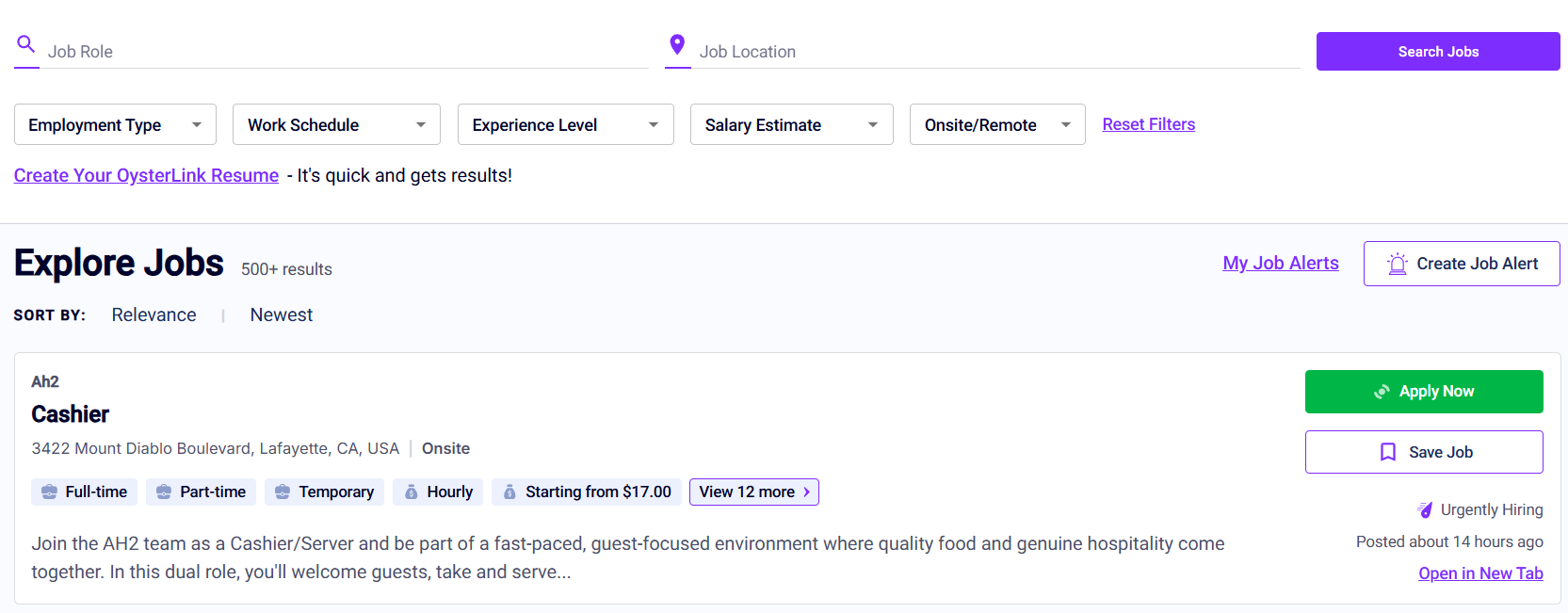
You can start off by exploring and browsing the available jobs we have on OysterLink. Then, sort by role, location and even things like salary and work schedule.
You can also use the search bar below when you're ready to land your next job!



The Fastest Growing
Restaurant & Hospitality Job Platform
Looking for top paid jobs? Or Hiring for your business?
Step 2: Write an Effective AI Prompt
Being specific will yield better results when using AI tools such as ChatGPT. Your prompt should always spell out:
- The exact job (not just “front desk,” but “Fine-Dining Server” or “Club Lounge Attendant”, etc.)
- Company and property (boutique hotel, theme park resort, airport Marriott... whatever fits)
- Your “edge” or background, such as foreign language skills or high-pressure shift work
Here’s an example of a very simple but effective prompt that you can use, followed by how I used it to generate a response in ChatGPT:
"Generate 20 unique interview questions for a Guest Relations Agent at Marriott Orlando, including tricky customer scenarios. Please add model answers based on 2 years’ hotel front desk experience and a knack for resolving guest conflicts."
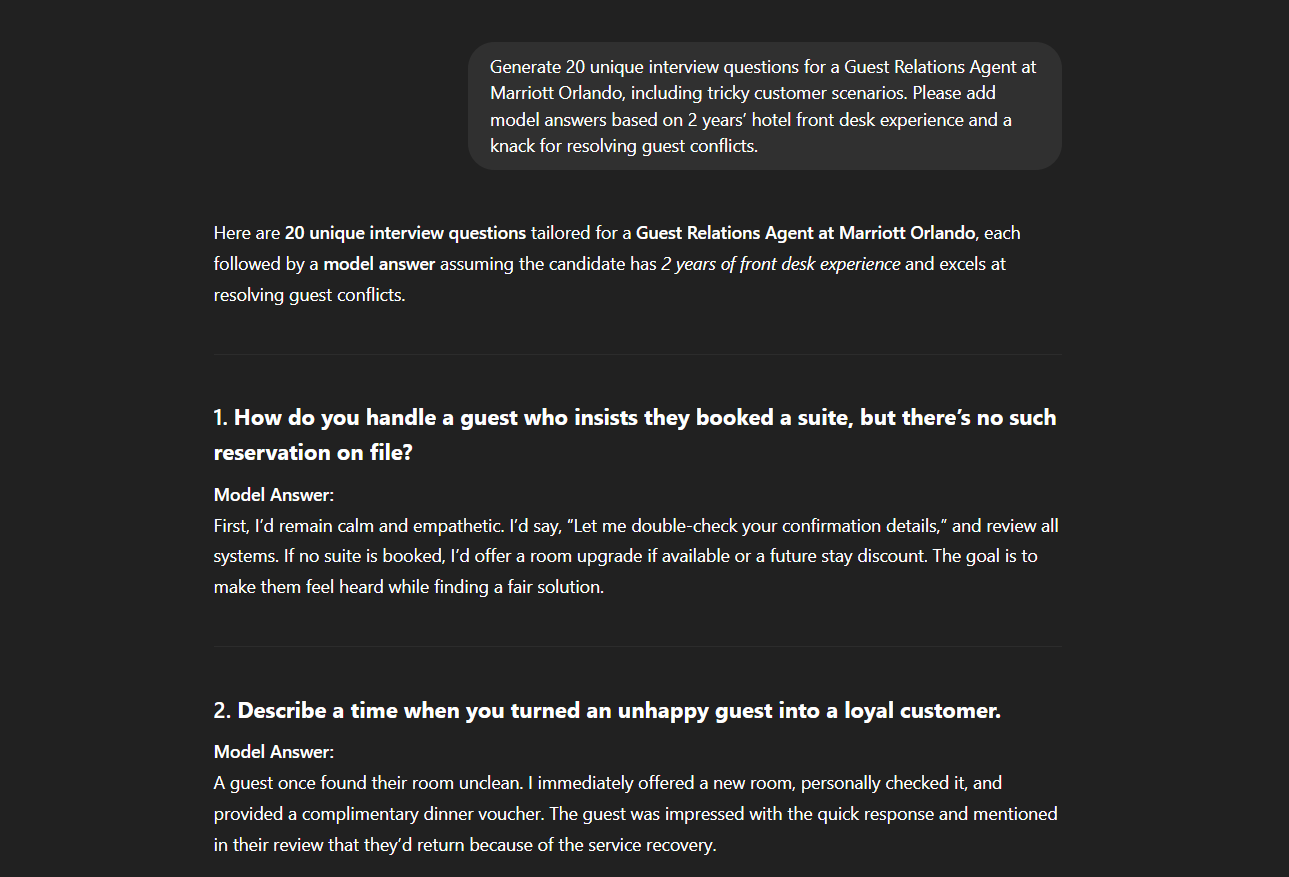
Don’t forget to save your best prompts for next time — make a screenshot or copy them to Google Keep so you don’t lose them.
Step 3: Review and Refine the AI-Generated Questions
Once you have a batch of questions, scan through them and highlight anything that stands out — such as questions about managing group check-ins, busy holiday weekends or surprise celebrity arrivals. If something feels too easy or too generic, update your prompt for the next round.
For additional inspiration, you might reference guides like how to interview a Bartender to see what expert interviewers prioritize.
If you want a challenge, ask ChatGPT for things like “five tough questions about mixology” or “give me more questions on handling a front desk overbook situation.”

Step 4: Practice With Sample (Model) Answers
Model answers from AI are a decent launchpad, but resist the urge to memorize them. Instead, tweak them according to your experience and your own style.
For example, describe a real incident (“last summer, there was a power outage in the hotel I worked at during check-in — I kept guests calm and handed out bottled water”), include concrete metrics or facts, and reflect on what you’d do differently now.
Record yourself in voice memos, then play it back. You might catch awkward phrases or realize you’re speaking too fast — most people do!
Hospitality job seekers looking to branch into niche roles should also explore our Barista interview tips or browse Restaurant Manager interview questions for a broader skillset.
Check Our Career Growth Tools


Step 5: Simulate Full Interviews
Mock interviews are a game changer. Try role-playing with a friend who’s worked in hotels or let ChatGPT act as your interviewer.
If you know which company you’re applying for or the specific locale (like “Applebees in New York City” for example), you can mention that to ChatGPT to get an even more accurate representation of what your hiring manager might actually be like.
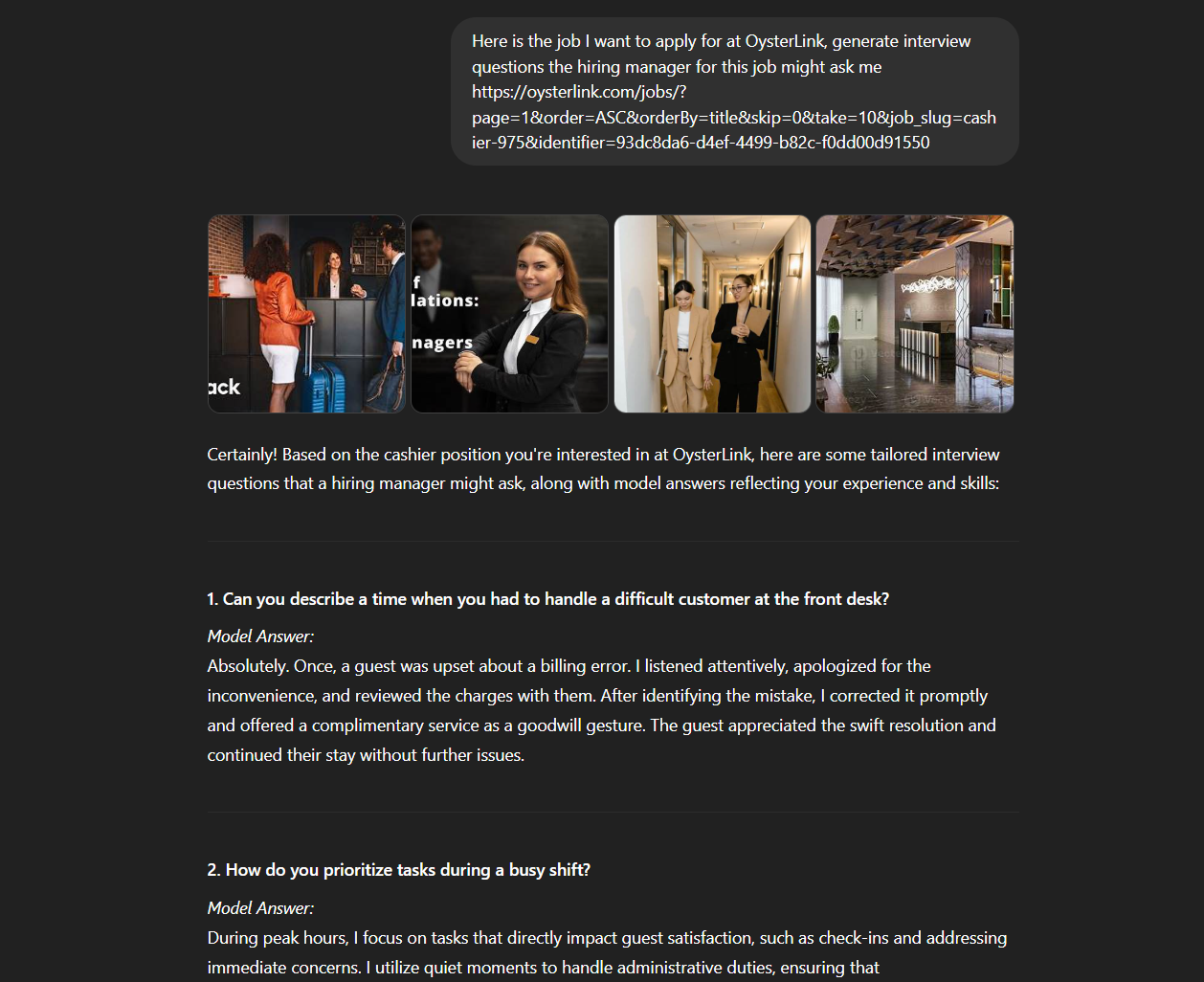
Another great tip is to paste the actual job description when asking ChatGPT (or other AI such as X’s Grok) to simulate a mock interview.
If the AI knows what the job you’re applying for is actively looking out for, it’s much more likely to accurately portray the hiring manager and what they’ll ask you during the interview.
Give yourself 20 minutes per “interview” and write down a quick post-game summary of what felt strong (or fell flat). After a couple of these, you’ll notice you’re quicker on your feet and sounding less like you’re reading a script.
Remember to record yourself and review the videos afterwards. It’s a great way to see what you’d look and sound like to the interviewer.
How AI Helps Identify Your Strongest Hospitality Skills
AI can help candidates recognize strengths they may overlook especially transferable hospitality skills. By inputting past roles, responsibilities and achievements, AI can highlight key skills such as guest communication, multitasking, conflict resolution and teamwork.
This is especially helpful for entry-level candidates or those switching roles within hospitality. AI can connect everyday tasks like handling reservations or resolving guest complaints to professional skills interviewers look for.
Once identified, these strengths can be woven into interview answers making responses more focused and relevant. This helps candidates clearly communicate their value and align their experience with what hospitality employers expect.
Advantages of Using AI for Interview Preparation
Even if you only have a short window to prepare — say, 10 minutes before an interview — you can still make a meaningful impact on your performance. Quick, focused prep helps you calm nerves, frame your story and prioritize what matters most in a conversation with a hiring manager.
That’s exactly where AI can shine: offering fast, targeted practice questions, personalized feedback and instant insights that would take much longer to pull together on your own.
Here’s a quick video that shows how to prep effectively when time’s tight:
1. Tailored Practice and Always Relevant
AI is able to come up with role-specific questions and make them as generic or specific as you want them to be.
Plus, if you paste the actual job description into the AI chat, it will analyze what the job calls for and it will ask you relevant questions related to that specific job, not just the role.
For in-depth practice, you can review specialized sample sets such as the Bartender job description or Director of Restaurant Operations job description so you match exactly what Hiring Managers expect.
2. Behavioral and Industry-Specific Questions
Hospitality interviews nearly always touch on soft skills (“describe a tough guest” or “tell us about teamwork”), plus practical operations (“run me through your check-in steps”). With AI, you can generate an unlimited number of behavioral questions, a lot of which you might have never came up with on your own.
No two interviews are ever exactly alike, and AI can generate new curveballs as needed. The more time you spend using AI to prepare, the more you’ll run into questions and scenarios you hadn’t encountered before, making you that much ready for the actual interview.
3. Immediate Feedback and Self-Improvement
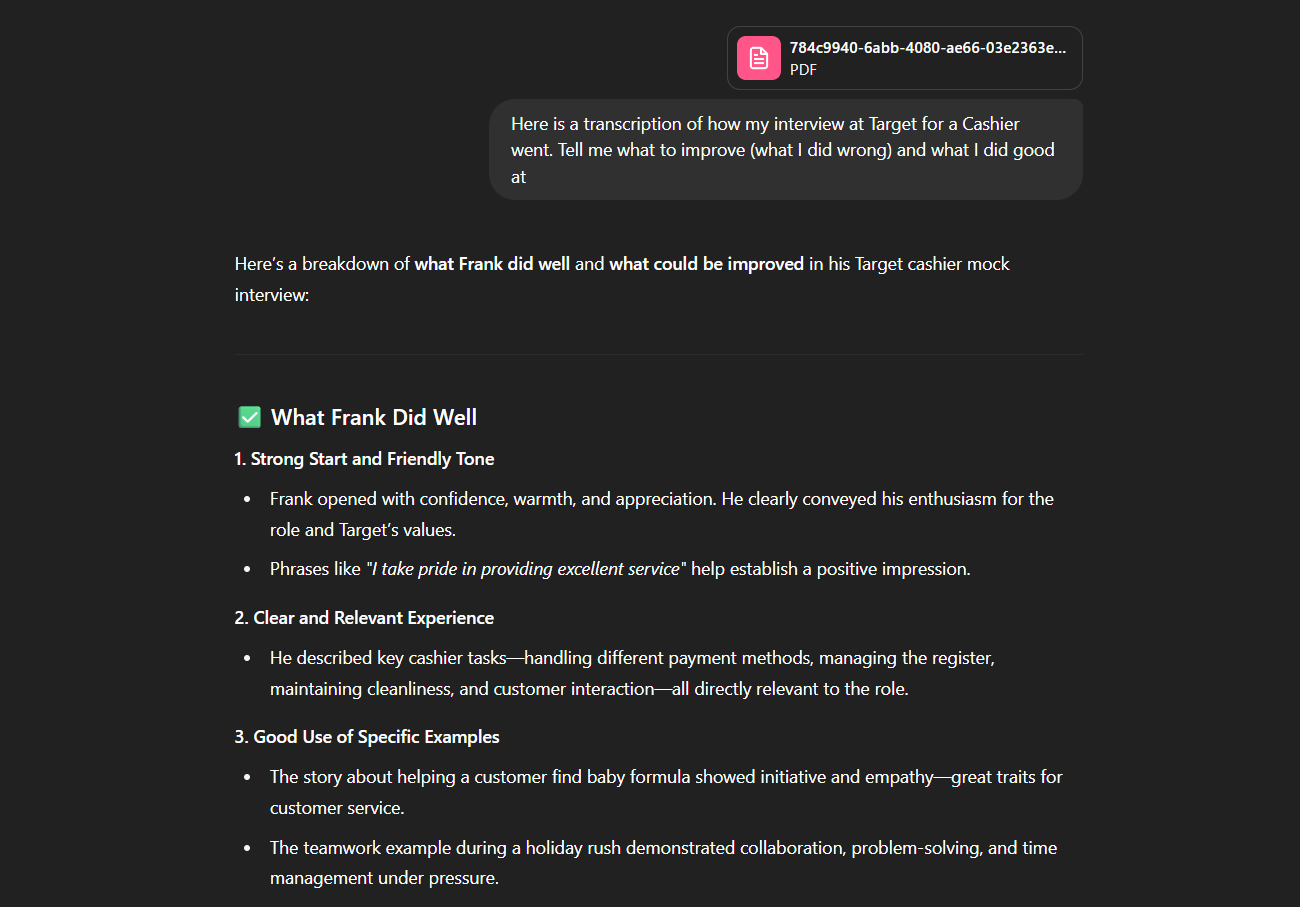
Remember that you can use the same AI (although you can maybe start a new chat) to review your answers and see how you did. You’ll get praise for what you did right and actionable feedback on what to do in order to improve.
Here's how you can prompt ChatGPT to analyze how your interview went, for example (I sent a transcription over from a mock interview in this case).
Tips for Maximizing Success in Hospitality Interviews
In addition to everything mentioned above, here are a few tips that will help you utilize AI like a pro and allow you to get the most out of it.
1. Customizing the AI Prompt for Your Experience
When prompting the AI, you can customize it by listing your entire hospitality experience — years, past brands, power skills (like “expert in Opera PMS” or “bilingual in Spanish and English”).
For those pursuing bar or beverage roles, polishing your credentials by referencing the master guide to being a good Bartender can set you apart during AI practice.
The more information you give the AI, the more it can adapt to you and your experience, coming up with more relevant answers and giving you better feedback, such as what you should mention/highlight that you might have over most other candidates.
2. Integrating Feedback from Real Interviews
After an actual interview, note any surprise questions, like “How would you de-escalate an angry wedding guest at 3 a.m.?” and add those to your next AI prompt for more realistic practice.
According to multiple people on various Reddit threads, it can take anywhere from 25 to 75 applications just to get one interview, and you might go through multiple interviews before you land a job.
That’s why constantly improving your communication skills and learning from past interviews is so crucial.
3. Building Confidence Through Repetition
Set aside regular 20-minute windows for interview prep. A few short bursts each week will win every time over one long marathon session. As you get more and more comfortable, you’ll be able to tweak your stories and find ways to sound more at ease.
Practice with a buddy when possible, or critique each other’s mock interviews to spot blind spots. The difference in your delivery, over time, will be huge.
You can do this even after you land a job, since you never know when you might decide to use your communication skills to negotiate for better pay or ask for more benefits.
Hospitality Interview Prep: Common Mistakes To Avoid
AI can be a powerful interview prep tool but only when used thoughtfully. One of the most common mistakes is relying too heavily on AI-generated answers without personalizing them. Hospitality employers want real examples of guest interaction, teamwork and problem-solving not polished but generic responses.
Another pitfall is using vague prompts. When candidates don’t specify the role, venue type or their own experience, AI tends to produce broad answers that won’t stand out. To avoid this, always include details like job title, service style and years of experience.
It’s also important not to memorize AI answers word for word. Instead, use them as a guide to structure your response then practice speaking naturally in your own voice. Authenticity and confidence matter just as much as preparation in hospitality interviews.
Preparing for Hospitality Interviews Using AI: Conclusion
Preparing for a hospitality interview using AI can give candidates a strong advantage when done correctly. From identifying key skills to practicing answers and avoiding common mistakes, AI works best as a support tool not a shortcut.
When paired with real experience, thoughtful prompts and personal storytelling, AI can help candidates feel more confident, prepared and professional going into their interview. In an industry built on people skills, the goal is not perfect answers but authentic ones that show a genuine commitment to guest service.

![11 Pros and Cons of Being a Pastry Chef in [year]](/content/spotlight/28d415b7-2c06-4ad2-aaa8-0e496fb422f7/poster/1758793953397-pros-and-cons-of-being-a-pastry-chef-featured-340x191.webp)
Loading comments...