


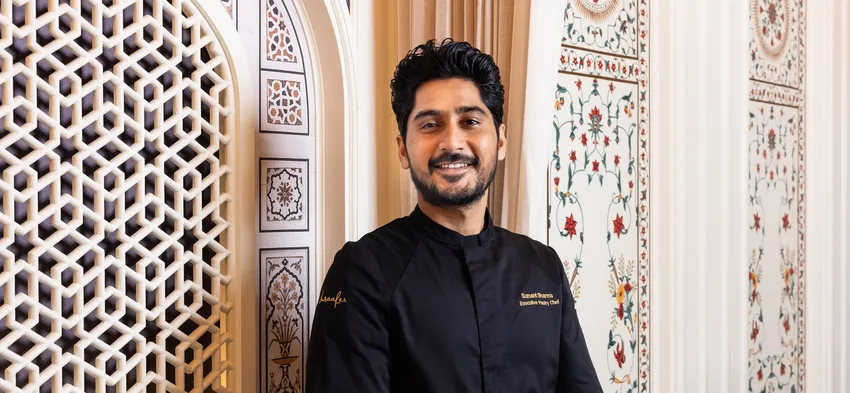

Combining his farming roots with professional pastry training, Sumant Sharma discusses the "food therapy" he provides at Musaafer. He advocates for hard work and discipline and warns against "job hopping" as a career red flag.
Please introduce yourself and tell us a bit about your career path.
Sumant Sharma: Yes, so my name is Sumant and I come from a farmer's family. I'm from India. So coming from a farming family and becoming a pastry chef, it was not a conventional journey. It's a very interesting journey where I was a student of biology science having the dreams of becoming a doctor. I joined hospitality where I did my hotel management and I became a pastry chef. So I did my hotel management from Jaipur. This is a place in Rajasthan. I did my culinary institute, culinary bachelors from there. And then I did my industrial training from Rambagh Palace.
So I've been working in so many kitchens and they have taught me so many various important ways which a chef should learn. So I've been a part of five pre-opening teams of various hotels and restaurants. So I did the opening of Hyatt Raipur, Marriott Jaisalmer in India, then Al Bait Chetty in Sharjah UAE, and I did my management training from Singapore and finally in 2019 I landed in USA and I joined the company The Spice Route Musaafer Houston and yeah that was the first place in USA where I started my Indian pastry program and right now I am here in New York and heading as an Executive Pastry Chef both the locations Houston and New York.
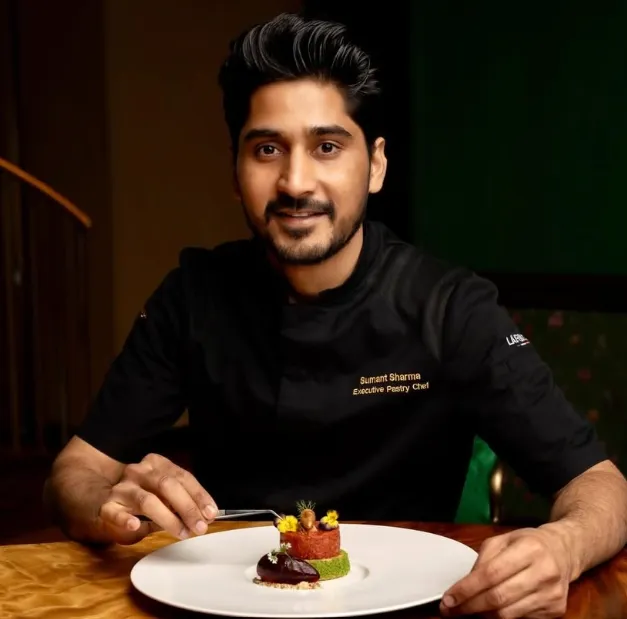
You went from a science track to pastry. How did that happen? Why did you decide to change from science to pastry?
Sumant Sharma: So that's something like I would say it's accidental because on that time I was literally confused in hospital and hospitality and that's like that's true honestly speaking I was like confused in both the words hospital and hospitality and I got selected in veterinary doctors you know the doctor for the animals and I got a good rank and I was like admitted in government institution in Delhi but suddenly I got a call from my uncle and he said that I used to do hotel management and on that time I was like I'm speaking honestly I was clueless that what's the hotel management is.
So I said, okay. And then I came back from Delhi to Jaipur and I got admitted into the culinary institute. Later I realized, okay, I'm not curing people through the medicines, but yes, I'm giving true joy through my food. So basically I'm just treating the people through my food therapy.

That's a nice way to put it. I mean, correct me if I'm wrong, you say that you come from a farming family? How did they take your decision switching from hospitals to hospitality, to pastry? How was that for them?
Sumant Sharma: So, you know, like my family is like a farming family while teaching background as well like me and my mother like I have done farming with my mother and my father is the teacher. So like half and half. So my father has little you know like ideas about what hotel management is but my mother was the same like me. She didn't have any idea about the hotel management. Yeah, so they like my uncle, he was a PhD professional, right? So each and everyone was trusted with his decisions. So he was the one who took all our, you know, educational decisions. And when he decided to put me in this hotel management, you know like in a culinary institute so each one of us was highly trusted on him and now I would say that yes we trusted on that time and this is the time like I'm enjoying the whole you know like on that decision on that day.

If you could write one sentence on the wall for every new pastry cook walking into your kitchen, what would it say? What would that sentence be?
Sumant Sharma: So this is I would say culture. I mean, because the creations which I do in my kitchen, this is not something which I do to get recognition. I firmly believe that a good work is something where you preserve the authenticity, where you celebrate the culture and you always keep alive the soul of the product. So whatever I create inside my kitchen, the pastries, they are always highly connected to my roots. And these are the celebrations of true Indian culture where we always say, Atithi Devo Bhava. And at the same time, we always care for the health and happiness of each one of us, to our customers, to our guests, to our family. I think that's what you wanted to ask me, right? Is that the right answer to the question?

I have to ask you another question about that. When did you first realize that Indian sweets were underrepresented on a global stage and that you want to bring something new?
Sumant Sharma: So initially I have been trained in the Western pastries. So when I was like entering into the Western world of pastries, I realized that Indian confection is among the greatest, know, like greatest technically sophisticated confection. So I would say the ancient Indian confection has already existed all those methods, the processes which we are seeing in this modern pastry world. Like there was, I would say like a reduction, caramelization, fermentation.
These all processes which we are doing in this modern, you know, like a contemporary pastry world was already existed in the ancient Indian kitchens. So when I saw that, okay, the Indian pastry has that much, you know, that much work already has been done and which I'm learning now in this modern world. So on that point, I came that, okay, now I have to work on the authentic. I have to work on traditional and I have to relish the ancient Indian culinary wisdom. So that's how I have coming up with rediscovering those ancient Indian methods processes with this modern culinary science.

When you hire a pastry cook, what are you actually looking for in let's say the first 10 minutes of the interview? What do you look for in a potential candidate?
Sumant Sharma: So for me, like at some point I feel that I am a good teacher. So in my first 2-3 minutes, I always analyze the behavior, the attitude of the person who is sitting in front of me. For me, skills are secondary, attitude is the primary. Because when we have a positive attitude, we can definitely learn whatever we want to learn. So once I interview someone, my personal theory inside the kitchen is like I always divide my team in three skill sets.
The first is the kitchen organizers, the second one is the man organizers and third one is the work organizers. So the first one is the kitchen organizers . Like each and everyone has a different personality, each and everyone has different strengths So in the kitchen and my team I always find out the strength of the person. Okay, the first one looks like they are good at kitchen handling, the second one, they are good at man handling and the third one is good at work handling so I bring all of them. So first of all, I empower them in their strengths and later I start teaching them and like I start them empowering in the other skill sets as well. So I always divide these.
I always divide the people in these three categories and that's what I look for in during my recruitment process. So I balanced always. It's not like everyone is like, okay, the kitchen organizer or just like they are good at their skills, but they are not good at manhandling or kitchen handling. So I always balance in all three categories. And on that, I started building them up in the other skills.

What is one thing that if someone did or someone said or something you find in a resume that makes you decide right away this is not going to pass?
Sumant Sharma: So, this is like quite difficult for me to find out because you know like I have seen so many times there is a few people they are like a worse during the interviews but they are very good at work and I found few people they are very good during the interviews but they are not good at work so it's quite difficult to decide through the resumes.
But when I found a red flag on someone when they have like literally so many you know like if they are changing so quick so that gives me a little red flag they might be good at their skills they might be extraordinary people or maybe intelligent people but if they doesn't have stability then it's a red flag for me because I spend a lot of time and energy behind each one of them to get them trained to make them efficient to work inside a kitchen and once they like quick just after one month or two months or three months I feel like this is a waste of my time, waste of my energy. So that's the one thing which I always keep one measurement as a red flag that how quick he is jumping he or she.
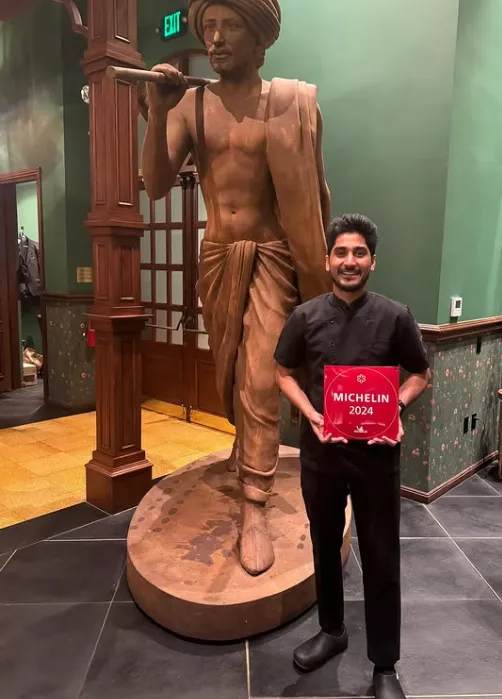
Let me now wrap up with one question. If someone is watching this, someone early in their career who is dreaming about becoming you in the future, someone who wants to be in your position in 10 years, what would you advise them to start doing as of today?
Sumant Sharma: So, like there's one thing which I have learned during this my entire career and not just through the hotels, through my background from my home. So resilience and consistency. These are the two things which I have learned through my farming background from my mother, from my father. So the resilience, patience and hard work I learned from my mother and discipline from my father. He's a teacher. And these are few things which are most important when you are in any kind of any kind of, you know, like a work. It's not just the kitchen. It can be anything for me. Speaking English is a big challenge for me. English is not my first language.
So I'm not good at sugarcoating my words. So what is left to me is the hard work and the original. We are original, hardworking and resilient. So whatever I create during my work, I always make sure of that product because I cannot sugarcoat through the words. So I need to keep my sugar which I'm serving on a plate. It should be louder where I don't need any words to speak about. My product should speak louder. But the one line if I answer is like where we begin will not decide where we can go. So it means where I am today that will not decide where I will be tomorrow. Only the things which will decide my way, my path is hardworking, honest to your work, be resilient, be original. These are the three, four things which I am following and I firmly believe in that.

You just broke down resilience in the best way when you said it's hard work and discipline from your father and your mother.
Sumant Sharma: Yes, so hard work in the sense like each and everyone wants to do the work. Hard work means we are very vigilant, we are very smart, and intelligent. Hard work like I would not mention here in particular but you know like there are so many people they work so hard but it's not that impactful. So you have to understand the place where you are working and how you have to deliver the things. So like working smartly and working intelligently is so important while you are working in the kitchen. Hardworking means like taking your place seriously, taking your trade seriously.
Hardwork doesn't mean like you coming here working from morning to evening and throwing the things in the garbage. That's not hard work. That's just a waste of your work, right? Hard work means plan your work and like we go in depth into it. Use the smart ways you can finish them quickly, less time, more productivity. And hard work means I mean, like you have to make a you have to make your dreams your life.
Like whatever you dream, you have to make them your life. And once you make them your life, then you will think about them. Even when you are sleeping, even when you are awake or even when you are walking or eating. So that's the hard work. Hard work doesn't mean physical work. Hard work is physical, mental. Your thought process should be like that. And discipline. Discipline is like if, consistency. Consistency is the discipline and hard work is the resilience. When you decide something, yes, I don't care how much I have to work for it, I will achieve it. That's hard work. And discipline, yes, I will be consistent. I will be regular until I'll not achieve what I have dreamed. So those two things like hard work and discipline go parallely to achieve what you want to achieve and what you have dreamt about.
Check out more interviews like this brought to you by OysterLink to learn about the industry. You can get them straight to your email by creating an OysterLink account and joining our newsletter.

Loading comments...