


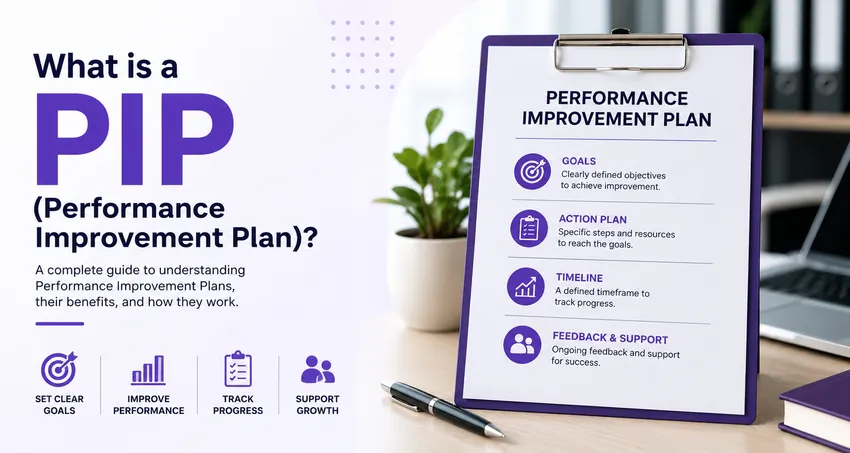

A Performance Improvement Plan (PIP) is a formal HR tool that creates a documented roadmap for employees who are struggling to meet job expectations.
Rather than an immediate dismissal, a PIP gives both the employer and the employee a structured framework — typically spanning 30, 60, or 90 days — to identify performance gaps, set measurable goals, and track progress through regular check-ins.
Used correctly, PIPs serve as a last line of support before more severe disciplinary action and create a clear paper trail that protects both parties legally.

What Does a Performance Improvement Plan Actually Include?
A well-drafted PIP is far more than a warning letter. It is a formal, written document that typically contains six core components:
- A clear description of the performance problem. This section outlines the specific behaviors, metrics, or outcomes that are falling short — such as missed sales targets, excessive absenteeism, or repeated errors in deliverables. Vague language like "bad attitude" is not sufficient and can render a PIP legally vulnerable.
- Measurable, time-bound goals. Effective PIPs follow the SMART framework (Specific, Measurable, Achievable, Relevant, Time-bound). For example: "Achieve a minimum customer satisfaction score of 85% for three consecutive weeks by [date]."
- A defined review period. Most PIPs run for 30, 60, or 90 days, though this varies by company policy, industry, and the severity of the issue. Longer timelines are common for complex performance issues that require skill development.
- Resources and support. The employer's obligations are also documented here — including training sessions, mentorship, additional tools, or adjusted workloads provided to help the employee succeed.
- Consequences for non-compliance. PIPs must be transparent about what happens if targets are not met. This is typically further disciplinary action up to and including termination.
- Signatures from both parties. Signing a PIP is not an admission of guilt by the employee — it simply acknowledges receipt of the document. Employees should understand this distinction before signing.



The Fastest Growing
Restaurant & Hospitality Job Platform
Looking for top paid jobs? Or Hiring for your business?
Why Do Employers Issue Performance Improvement Plans?
Employers initiate PIPs for a range of performance-related reasons, but the core motivation is almost always the same: to create a documented, good-faith effort to resolve the issue before termination becomes necessary.
Common triggers include consistently missing KPIs or productivity benchmarks, poor quality of work or high error rates, interpersonal or conduct issues affecting team performance, unexplained absenteeism or tardiness patterns, and failure to adapt following previous verbal or written warnings.
From a legal standpoint, PIPs also serve as critical documentation. Employment law in many jurisdictions requires employers to demonstrate that an employee was given a fair opportunity to improve before being dismissed.
Without a PIP or equivalent documentation, wrongful termination claims become significantly harder to defend. In this sense, a PIP protects the company as much as it is intended to help the employee.
It is worth noting that PIPs are not appropriate for every situation. A single isolated incident, a personality conflict, or a performance dip caused by a temporary personal crisis may call for coaching or an informal conversation rather than a formal plan.
How Should an Employee Respond to a PIP?
Receiving a PIP can feel like a gut punch — but how an employee responds in the first 48 hours often determines the outcome.
The worst reactions are denial, aggression, or doing nothing. The most effective response follows a clear sequence.
- Read the document carefully and ask clarifying questions. Employees should fully understand every benchmark, timeline, and expectation before signing. It is entirely appropriate — and advisable — to ask for clarification on any ambiguous targets in writing.
- Request a meeting with HR or your manager. Use this opportunity to understand the support available, express commitment to improvement, and establish a communication rhythm for check-ins.
- Consult an employment attorney if something feels off. If the PIP appears retaliatory, discriminatory, or contains impossible-to-meet targets, legal advice may be warranted before signing. Some PIPs are used in bad faith as documentation to justify a predetermined termination — a phenomenon employment lawyers refer to as a "set-up-to-fail PIP."
- Document everything. From this point forward, keep records of all meetings, emails, and feedback. If targets are met and the employer still terminates, this documentation becomes essential.
- Focus on performance, not politics. Regardless of the circumstances, employees who treat the PIP as a genuine opportunity and exceed the stated targets are in the strongest possible position — whether they stay with the company or move on.
What Are the Most Common PIP Outcomes?
PIPs result in one of four general outcomes, and understanding each helps both managers and employees set realistic expectations.
- Successful completion. The employee meets or exceeds all stated benchmarks within the review period. The PIP is formally closed, often with a follow-up period of continued monitoring. In genuine PIPs, this is the intended outcome.
- Termination following failure. If the employee does not meet the stated goals by the deadline, the employer proceeds with dismissal. Because the expectations were documented and agreed upon, the legal exposure for the company is significantly reduced.
- Resignation during the PIP period. Many employees choose to resign rather than complete a PIP, particularly when they believe the targets are unachievable or the working relationship has broken down. In some jurisdictions, resigning during a PIP may still entitle the employee to certain severance rights — this varies by location and employment contract.
- PIP withdrawal or modification. Circumstances sometimes change. A manager may leave, the business may restructure, or new information may come to light. In these cases, the PIP can be formally withdrawn or its targets revised — always in writing.
The Difference Between a PIP and a Written Warning
PIPs and written warnings are both disciplinary tools, but they serve distinct purposes and carry different implications.
A written warning is a formal notice that a specific behavior or incident was unacceptable, and it typically lives in the employee's HR file. It is reactive — it documents what happened and states the expected standard going forward.
A PIP, by contrast, is forward-looking and active. It does not just say "this was wrong" — it prescribes exactly what must change, by how much, and by when, with structured support and regular review points built in.
A written warning might be issued after a single serious incident; a PIP is typically reserved for ongoing or systemic performance issues that have already been addressed through informal means or earlier warnings.
In a well-run HR process, the progression typically looks like this: informal conversation → verbal warning → written warning → Performance Improvement Plan → termination. However, the severity of the issue can compress or skip steps.
Check Our Career Growth Tools


Are PIPs Always Used in Good Faith?
This is one of the most contested questions in employment law and HR practice — and the honest answer is: not always.
When used correctly, PIPs are genuinely valuable tools that give struggling employees a fair chance to turn things around. Many employees have completed PIPs and gone on to have long, successful careers at the same company.
However, PIPs are sometimes issued in bad faith — used as legal cover to document a termination that has already been decided.
Red flags that may indicate a bad-faith PIP include targets that are vague or objectively impossible to achieve, a very short review window with no meaningful support offered, a PIP issued immediately after the employee raised a complaint or took protected leave, and managers who are disengaged from the review process.
Employees who suspect a bad-faith PIP should document everything, consider consulting an employment attorney, and begin exploring external opportunities — not because the fight is not worth having, but because career continuity is worth protecting regardless of the legal outcome.



Loading comments...